Muaz.io vs Median: rebuild your website as a native app, or package it as one
Median turns your existing website into an app that displays your web content with native extras. Muaz.io rebuilds your business as native screens designed for iPhone. Here is when each makes sense.
The short answer
Choose Median if your mobile website is already excellent, you want iOS and Android apps quickly, and you mainly need app store presence, push notifications and native extras around your existing web content. Median is a well-established product in this category and a pragmatic choice for content-heavy sites.
Choose Muaz.io if you want an app that feels native rather than web: native navigation, instant screens, gestures, Face ID, widgets and Apple Pay, designed for iPhone from your brand, with competitor research to guide what the app should do and a lower risk of App Review issues under Apple's minimum functionality guideline.
Compare for yourself in five minutes
Paste the same idea into Muaz.io and see research, design and a live iPhone preview before you choose.
Two different philosophies
There are two ways to turn a website into an app.
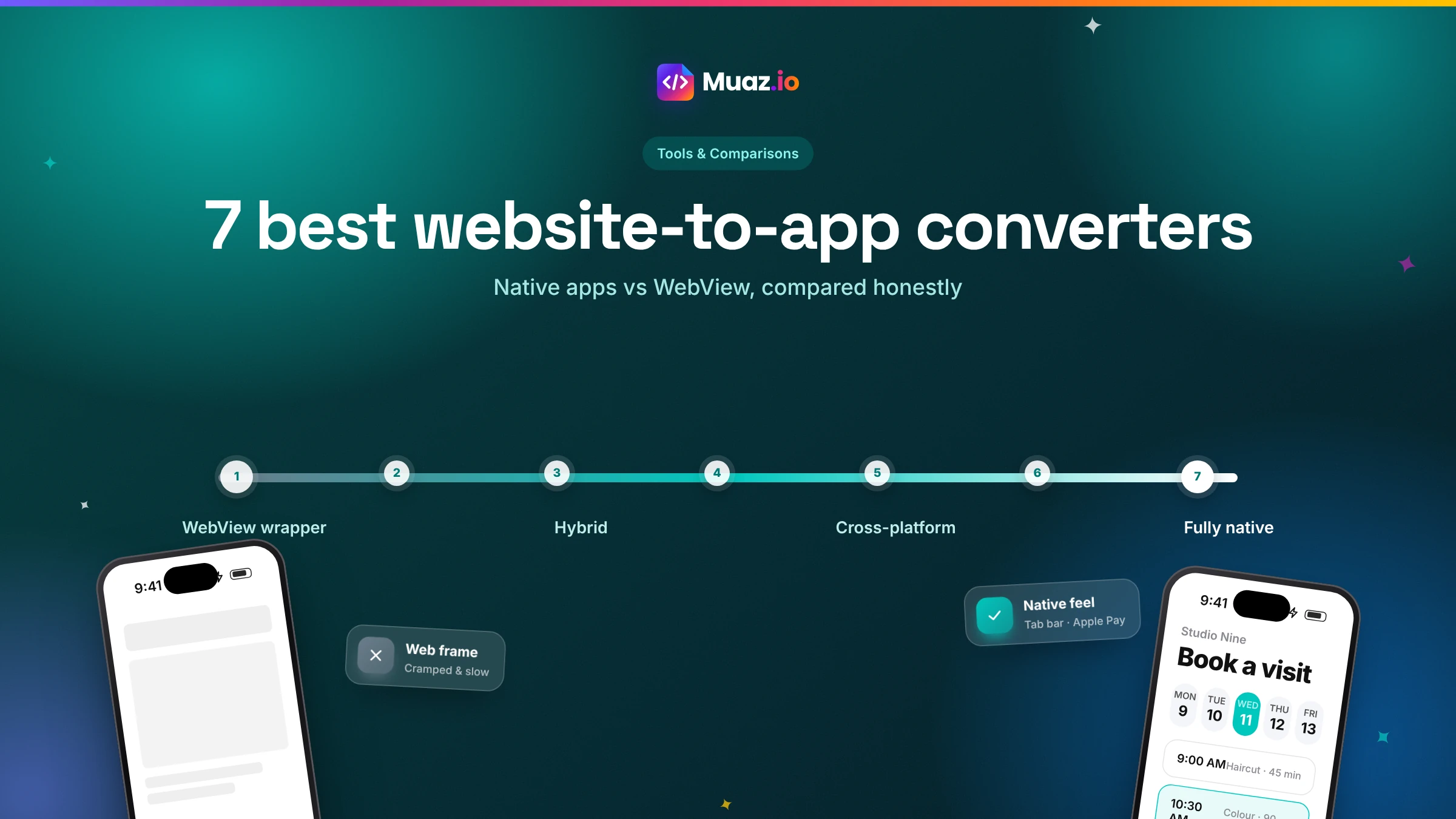
Package the website. The app is a native shell that displays your web pages, with native features added through a bridge. Median.co is a leading example; it describes connecting web content to device capabilities through its JavaScript Bridge and a library of plugins.
Rebuild as native. The website becomes the specification, and the app is rebuilt with native screens. Muaz.io's Website Intelligence Agent maps your pages, brand and flows, then the design and development engines produce a native React Native app that talks to your data through APIs. See website to app for the full process.
Side-by-side overview
| Muaz.io | Median.co | |
|---|---|---|
| Approach | Native screens rebuilt from your website | Your web content displayed in a native app |
| Feel | Native navigation, lists, gestures | Depends on your mobile website |
| Design | Three original concepts from your brand | Your existing website design |
| Native features | Face ID, push, widgets, Apple Pay, offline | Push, plugins and JavaScript Bridge |
| Competitor research | 5, 10 or 20 App Store apps | Not included |
| App Review risk (guideline 4.2) | Lower: designed for native value | Higher if the app adds little beyond the site |
| Platforms | iOS first, React Native for Android later | iOS and Android |
| Code | React Native + Expo you own | Platform-built apps |
| Pricing | Free to research and design | Free tier; paid from $229 one-time + $179/yr (Toolradar, Nov 2026) |
Where Median is strong
Median is fast and practical. If your site is responsive, well designed and frequently updated, packaging it means every website change appears in the app immediately, with no separate app content to maintain. You get iOS and Android together, push notifications and access to device features through plugins. For publishers, communities and internal tools where the web experience is already the product, that can be exactly right.
Where Muaz.io is different
It feels like an iPhone app. Native tab bars, swipe gestures, instant transitions and system typography make the app feel at home on iOS. Users notice the difference within seconds.
It is designed for mobile jobs. Websites are broad and shallow; apps are focused and deep. Muaz.io's Product Architect decides what belongs on the phone, what becomes a tab, what becomes a sheet and what stays on the web.
It adds features a website cannot. Face ID, home screen widgets, Live Activities, Apple Pay, offline mode and well-timed permission prompts are built in natively.
It starts with your market. Competitor research shows what successful apps in your category do, so your app is not just your website on a phone, but a better product than the alternatives. See competitor research.
It lowers App Review risk. Apple's guideline 4.2 asks for apps that are more than a repackaged website. A native app designed around mobile value is on the right side of that line.
Free: Website-to-App Readiness Report
We score your site on 12 factors that decide how well it converts into a native app.
We’ll email the resource and a few practical tips. Unsubscribe in one click. We never sell your data.
Pricing compared
Toolradar lists Median's plans, with prices confirmed on November 2, 2026: a free tier with Median branding; Starter at a one-time $229 plus $179 per year; Essential at $590 plus $399 per year; Plus at $3,290 plus $2,240 per year; a Business plan at $7,200 per year where Median's team builds and publishes the apps; and Enterprise on request. Check Toolradar's listing or Median's site for current details.
Muaz.io is free for research and design, so you can see your native app before you pay. Paid plans add builds and team features.
Content updates and maintenance
A packaged website updates when the website does, which is convenient. A native app built by Muaz.io reads live data, products, articles, bookings and accounts, from your APIs, so content updates also appear automatically. Layout changes require a new build, which Muaz.io produces and tests for you. Many teams find this a good balance: content stays in sync, while the app experience is designed specifically for the phone.
Which websites suit each approach
| Website type | Better fit | Why |
|---|---|---|
| News or blog with frequent articles | Either | Median keeps it simple; Muaz.io adds native reading and alerts |
| Online store | Muaz.io | Native checkout, Apple Pay and saved bags drive repeat sales |
| Booking or appointments | Muaz.io | Native calendars, reminders and Face ID login |
| SaaS dashboard | Muaz.io | Focused mobile jobs, widgets and push alerts |
| Community forum | Either | Depends on how good the mobile site already is |
| Internal tool already mobile-friendly | Median | Fast distribution without redesign |
Who should choose which
Choose Median if your mobile site is already great, you need both stores quickly and app store presence matters more than a native experience.
Choose Muaz.io if you want a native app experience, features your website cannot offer, competitor-led product decisions, lower App Review risk and code you own.
See your site as a native app
Paste your website URL into the builder at the top of this page. Muaz.io maps your pages and brand and shows you a first native concept on a live iPhone in minutes, free. Download the readiness report below to see how well your site will convert. For more alternatives, read the best AI app builders in 2026.
Performance and user experience
Speed is one of the clearest differences between the two approaches. A packaged website loads pages over the network, so performance depends on your site's speed and the user's connection. A native app built by Muaz.io renders screens on the device and caches data, so it opens instantly and stays responsive offline. Native lists scroll smoothly with thousands of items, forms use native keyboards and autofill, and transitions follow iOS conventions. These details are subtle individually, but together they decide whether an app feels like a shortcut to a website or a product people enjoy using.
Push notifications and engagement
Both approaches support push notifications, which are one of the main reasons businesses want an app. The difference is what happens after the tap. In a native app, a notification can open the exact screen with the right data already loaded, show rich media and offer actions on the lock screen. In a packaged website, the notification typically opens a web page inside the app. Muaz.io's Growth Studio also plans your notification strategy, asking for permission at the right moment and suggesting campaigns based on your research.
Migrating from a web-content app
If you already have a web-content app on the App Store, you can move to a native app built with Muaz.io without losing your listing. Publish the native version as an update to the same app record, keeping your name, ratings and reviews. Muaz.io's Publishing Agent prepares the update, new screenshots and release notes that explain the improvements to existing users.
Accuracy note
We cite third-party sources for Median's pricing and describe its product as presented on public pages. If anything is out of date, email support@muaz.io and we will correct it promptly.
Scenario comparisons
A news publisher. The site publishes dozens of articles a day and already works well on mobile. The main goal is a home screen icon and breaking news notifications. Median's approach is efficient here. Muaz.io would add native reading, offline saving and personalised alerts, which matter if the publisher wants to grow subscriptions through the app.
A boutique fashion brand. The brand wants repeat purchases, Apple Pay and drop alerts. A native shopping app built by Muaz.io gives a faster, more polished experience than the mobile site in a shell, with native checkout and a product page designed for thumbs. See Muaz.io for e-commerce.
A clinic with an online booking form. Patients want quick booking, reminders and secure access to their records. Muaz.io's native calendar, notifications and Face ID login suit the job; a packaged site would depend on how well the booking form works on mobile.
A SaaS dashboard. Customers want alerts, approvals and a widget for key numbers. A focused native companion app delivers those jobs better than the full dashboard in a shell. See Muaz.io for SaaS.
An internal tool already built for mobile. Employees need quick access, and the tool already works well on phones. Packaging it can be the fastest route to distribution.
Strengths summary
Median's strengths: speed to both app stores, automatic content updates from the website, push notifications, a JavaScript Bridge and plugin library for native features, and a managed service option where Median's team builds the apps.
Muaz.io's strengths: native screens designed for iPhone, competitor research to guide features, original design from your brand, native features such as Face ID, widgets, Live Activities and Apple Pay, lower risk under Apple's minimum functionality guideline, code you own, approvals and a growth studio.
What Apple's minimum functionality guideline means in practice
Apple's guideline 4.2 says apps should include features, content and UI that elevate them beyond a repackaged website. In practice, reviewers look for whether the app offers something a browser does not: native navigation, offline use, device features, notifications that link to useful screens and a design that feels at home on iOS. Many web-content apps add enough native value to be approved; some do not. When you build native screens around mobile jobs, as Muaz.io does, the app's value beyond the website is clear from the first launch, which reduces review risk and gives users a reason to keep it.
A closer look at the native rebuild
When Muaz.io reads your website, it does more than copy pages. The Website Intelligence Agent maps every public page, identifies the flows that matter, such as booking, checkout, sign-up or contact, extracts your brand tokens and lists the private APIs the app will need. The Product Architect then decides what the mobile app should be: which jobs become tabs, which become sheets or cards and which stay on the web. A long services page might become a searchable list with filters. A pricing page might become a native paywall or plan picker. A contact form becomes a native form with autofill. The result is not your website on a phone; it is your business designed for the phone.
Keeping web and app in sync
A common worry about native apps is keeping them in sync with the website. Muaz.io's apps read live data from your APIs, so products, prices, articles, bookings and account details update automatically. If your site uses a CMS such as WordPress or a headless CMS, content can flow straight into native screens. Only structural changes, such as a new section or a redesigned flow, need a new build, which Muaz.io generates and tests for you. That gives you the freshness of a web-content app with the experience of a native one.
Costs over time
The first-year cost of each approach includes more than the plan price. With a web-content app, the main ongoing cost is the plan plus any plugin fees, and the experience improves only when your website improves. With a native app built by Muaz.io, costs include the plan and builds for updates, but each update can add native features that increase engagement and revenue, such as widgets, Apple Pay or offline access. Compare the cost against the value of repeat usage: if the app becomes a channel your best customers use weekly, a better experience usually pays for itself.
Questions to ask before deciding
Is your mobile website genuinely excellent, fast and easy to use with a thumb? Do you need features a browser cannot offer, such as Face ID, widgets or Apple Pay? How important is App Store review risk to your timeline? Do you need Android at the same time as iOS? Do you want to own the app's code? Your answers point clearly to one approach or the other, and either can be the right choice for the right business.
Glossary for this comparison
Web-content app. An app that displays a website's pages inside a native shell, often with added native features.
Native app. An app whose screens are built with the platform's own components, running on the device.
JavaScript Bridge. A mechanism that lets web content call native device features in a web-content app.
Minimum functionality. Apple's guideline 4.2, which expects apps to offer more than a repackaged website.
WebView. A component that renders web pages inside an app.
Hybrid strategies
Some businesses combine both approaches. They build the core mobile jobs as native screens and keep rarely used, content-heavy sections, such as a long help centre or legal pages, as web views inside the native app. Muaz.io supports this: native screens for the experiences that matter most, with web views where a native rebuild adds little value. This hybrid approach keeps the app fast and native where users spend their time, while avoiding unnecessary work on pages people seldom visit.
Final verdict
If you mainly need your existing website in the app stores quickly, with notifications and a few native extras, Median is a practical, proven choice. If you want an app that feels native, offers features your website cannot, is designed around mobile jobs and is informed by competitor research, Muaz.io is built for that. Paste your website into the builder at the top of this page to see your first native concept in minutes, free, and judge the difference yourself.
Examples of native features a website cannot match
Face ID login. Customers sign in with a glance instead of typing passwords on a small keyboard.
Home screen widgets. Order status, next appointment or today's balance visible without opening the app.
Live Activities. Real-time updates on the lock screen and in the Dynamic Island, such as a delivery on its way or a booking countdown.
Apple Pay. One-tap checkout with saved cards and addresses, through your existing payment provider.
Offline mode. Recently viewed content and saved items available without a connection.
Context-aware notifications. Alerts that open the exact screen with data loaded, with actions directly on the lock screen.
Haptics and gestures. Subtle feedback and swipe actions that make the app feel responsive and physical.
Each of these is built natively by Muaz.io and designed into the right moment of the user journey, which is what turns an app from a shortcut into a habit.
Choosing with confidence
There is no single right answer for every business. If your website is the product and your priority is distribution, packaging it is a sensible, fast option. If your app needs to earn a place on customers' home screens with speed, convenience and features they cannot get in a browser, a native rebuild is worth it. Try Muaz.io's free concept step with your own URL, compare it with your mobile website side by side on your phone and let your customers' likely reaction guide the decision.
Your customers will feel the difference within seconds of opening the app, so test both with real people before you commit.
Start with your URL above; the first native concept is free and takes minutes.
We update this comparison when either product changes, so check back before you decide.
Thanks for reading, and good luck with your app.
Still have questions about median app alternative? Ask the assistant inside the Muaz.io builder. It knows your project, your competitors and every source cited in this guide, and it answers in plain language.
Questions about muaz.io vs median.co
Short, direct answers. Still curious? Ask in the builder; the assistant knows your project.
What does Median do?
Median.co (formerly GoNative) converts a website into iOS and Android apps that display your web content, extended with native features through its JavaScript Bridge and plugins such as push notifications. It is a fast way to get an existing site into the app stores.
What is the difference with Muaz.io?
Muaz.io reads your website as a specification and rebuilds the experience as native screens: native navigation, lists, forms, gestures and device features, designed for iPhone. Your web content informs the app; it is not displayed inside it.
Will Apple accept a website-based app?
Apple's guideline 4.2 on minimum functionality says apps should offer more than a repackaged website. Many web-content apps are approved when they add real native value, but the risk of rejection is higher than for a native app. Muaz.io designs for native value from the start.
How do the prices compare?
Toolradar lists Median plans, confirmed November 2, 2026, from a free tier with Median branding to Starter at a one-time $229 plus $179 per year, Essential at $590 plus $399 per year, Plus at $3,290 plus $2,240 per year, and a Business plan at $7,200 per year where Median's team builds the apps. Muaz.io is free to research and design.
When is Median the better choice?
When your website is already an excellent mobile experience, you need iOS and Android quickly, and you mainly want app store presence, push notifications and a home screen icon without redesigning anything.
Do I lose my website if I use Muaz.io?
No. Your website stays exactly as it is. The app uses the same backend and data through your APIs, so both stay in sync.
Guides on this topic

Related guides and tools
Convert your website into a native iPhone app with AI. Muaz.io reads your brand, pages and flows, then builds real native screens, not a WebView wrapper.
Read the guide Compare · 13 min readThe best AI app builders in 2026, compared honestlyA sourced comparison of the best AI app builders for iPhone apps in 2026: Muaz.io, Rork, FlutterFlow, Lovable, Bolt, Adalo, Bubble, Thunkable and Median.
Read the guide Compare · 13 min readMuaz.io vs Rork: research-first app building vs chat-first app buildingAn honest, sourced comparison of Muaz.io and Rork: native output, competitor research, website-to-app, voice editing, approvals, publishing, growth and pricing.
Read the guide Compare · 13 min readMuaz.io vs FlutterFlow: an AI team that builds for you vs a visual builder you driveCompare Muaz.io and FlutterFlow on how apps are built, AI depth, competitor research, code ownership, publishing, team workflows and 2026 pricing.
Read the guide Solutions · 13 min readTurn your store into the shopping app your best customers open every weekConvert your Shopify, WooCommerce or custom store into a native iPhone shopping app with Apple Pay, push notifications for drops and loyalty, built with AI.
Read the guide Solutions · 13 min readGive your SaaS the mobile app your customers keep asking forGive your SaaS a native iPhone app that uses your existing login and API: push alerts, widgets, Face ID and offline access, built and launched with AI.
Read the guideWhere our numbers come from
Third-party figures are estimates published by the sources below. Prices and rules change; check the source before you decide.
- Median.co official websitemedian.co
- Toolradar: Median.co pricing (confirmed Nov 2, 2026)toolradar.com/tools/median-co/pricing
- Apple App Store Review Guidelines 4.2: Minimum functionalitydeveloper.apple.com/app-store/review/guidelines/#minimum-functionality
- Apple Human Interface Guidelinesdeveloper.apple.com/design/human-interface-guidelines
- React Native documentationreactnative.dev
Your app is one sentence away.
Paste the same idea into Muaz.io and see research, design and a live iPhone preview before you choose.