Launch your startup's app without waiting for a technical co-founder
Validate the market, design an original product, ship a native iPhone app and start learning from real users, in days rather than months, while you keep the code and the customer relationship.
The founder's dilemma
You have an idea, maybe even early customers asking for it, but no app. The traditional paths all have a catch. Hiring an agency costs a lot and takes months before you see anything you can test. Finding a technical co-founder can take longer than building the product. Learning to code is a worthy goal, but it pulls you away from the work only you can do: talking to customers, raising money and selling.
Meanwhile the market moves. Appfigures data reported by TechCrunch showed new iOS app releases up 80% year over year in the first quarter of 2026, driven in part by AI tools that make building faster. The founders who win in that environment are the ones who learn fastest from real users.
Muaz.io gives you a fourth path. You bring the insight; ten AI agents handle research, design, engineering, testing and launch preparation. You approve each step, and you own everything that is built.
See what your app would look like
Paste your site or describe your business. You get competitor research and three original concepts, free.
Start with evidence, not a hunch
Most founders start by designing screens. Muaz.io starts by studying the market. Before a single pixel is drawn, the Discovery Engine researches 5, 10 or 20 apps in your category on the App Store: their screenshots, ratings, pricing, update frequency and what users praise or complain about in reviews. Where licensed providers supply them, revenue and download estimates are shown with their source; otherwise the field says "Unavailable".
That research answers the questions investors and early hires will ask. Who else does this? How do they make money? Where are users unhappy? Which App Store keywords are crowded and which are open? You get a clear picture of the opportunity, and the product brief is written around the gap you found. The competitor research page explains the method in depth.
From idea to a brief you can defend
The Product Architect Agent turns your idea and the research into a one-page brief: the target user, the problem, the core journey, launch features and later features, the screen map, the monetisation model and the positioning against competitors. It is short enough to share with a co-founder or advisor, and specific enough to build from.
You can edit any part of it by voice. "Make the first version only about booking, no payments yet" trims the scope. "Add a referral reward" adds a growth mechanic. When you approve the brief, it becomes the source of truth for design and code.
A design that does not look like every other MVP
Template-based builders tend to produce apps that look the same. Muaz.io designs from your brand and your research. You get three original concepts, Minimal Apple, Modern SaaS and Premium Futuristic, each rendered on a live iPhone with a real lock screen, notifications and Dynamic Island so you can judge it as your users will see it.
Change anything by voice or text: "make the onboarding two screens", "use our orange", "move the paywall after the first booking". Every change is a version you can compare and restore. Designs follow Apple's Human Interface Guidelines for touch targets, contrast and Dynamic Type, so accessibility is built in from the first version.
A real native app, not a website in a frame
Muaz.io generates a React Native and Expo project with real native navigation, gestures and device features. That matters for two reasons. First, users can feel the difference: native apps are faster, smoother and integrate with Face ID, notifications, widgets and Apple Pay. Second, Apple's review guidelines expect apps to offer value beyond a repackaged website, so native builds face fewer rejections.
You do not have to understand the code, but it is there whenever you want it: typed, organised and documented. If you later hire engineers, they start from a solid foundation instead of a rewrite.
Test with real users this week
The fastest way to learn is to put the app in people's hands. Muaz.io prepares a TestFlight build you can install on your own iPhone and share with early users by email or public link. Watch them use it, gather feedback and apply changes by voice. Each new build takes minutes.
A sensible first-week plan for a founder looks like this:
- Day 1: Paste your website or describe the idea, run research and approve the brief.
- Day 2: Choose a design concept and refine it by voice.
- Day 3: Review the first build on your iPhone and fix what feels off.
- Day 4: Invite 10 to 20 early users through TestFlight.
- Day 5 to 7: Watch sessions, collect feedback, ship two or three improvements.
By the end of the week you have something most founders do not reach for months: real usage data.
Free: The Founder's MVP Scorecard
Score your app idea on demand, competition, monetisation and build effort before you spend a dollar on development.
We’ll email the resource and a few practical tips. Unsubscribe in one click. We never sell your data.
Monetise from day one, the smart way
Revenue is a signal investors trust. Muaz.io adds in-app purchases and subscriptions with the paywall placed where it makes sense for your category, and the Growth Studio starts from published benchmarks. RevenueCat's 2026 State of Subscription Apps found that hard paywalls convert trials to paid at roughly five times the rate of freemium models by day 35, and that trials of 17 to 32 days convert about 70% better than trials under four days.
Those are starting points, not rules. Use the free app revenue calculator to model your own assumptions, and the paywall teardown to check your paywall against conversion patterns and Apple's subscription rules before you launch. Many small developers also qualify for Apple's Small Business Program, which reduces the commission on paid apps and in-app purchases.
What it costs compared with the alternatives
| Path | Time to a testable app | Upfront cost | Who owns the code | Market research included |
|---|---|---|---|---|
| Development agency | Typically months | High | You, per contract | Rarely |
| Freelance developer | Weeks to months | Medium to high | You, per contract | No |
| Technical co-founder | Depends on finding one | Equity | Shared | Depends |
| Template app builder | Days | Low | Often the platform | No |
| Muaz.io | Days | Low, free to research | You | Yes, 5 to 20 apps |
The right answer depends on your situation. Agencies make sense for complex, regulated products with large budgets. A technical co-founder is invaluable for a deep-tech company. For most consumer and small-business apps, getting a native first version into users' hands quickly is what matters most.
Pitching with a live app
A live app changes the fundraising conversation. Instead of describing a product, you hand an investor your phone. Instead of guessing at the market, you show a sourced competitor analysis. Instead of promising to learn, you share retention numbers from your first users.
Muaz.io helps with the materials too. The research report can be exported with every figure labelled by source. The growth plan shows the experiments you will run in the next 90 days. And because the code is yours and standard, there is no platform risk to explain in due diligence.
Naming, icon and App Store page
Founders often stall on naming and branding. The free app name generator produces brandable names that fit Apple's 30-character limit, and the app icon maker creates a clean 1024 by 1024 icon you can refine later. When you are ready to publish, the App Store Studio prepares screenshots, metadata and privacy labels, and the ASO keyword tool helps you write a keyword field that does not waste a character.
Keeping control as a founder
Speed is only valuable if you stay in charge. Every consequential action in Muaz.io requires your approval: connecting to a live API, spending money, uploading a build with your Apple account and submitting for review. Every agent action is recorded in an audit log. Your secrets stay on the server and never ship inside the app. And because you own the code, you can leave at any time and take everything with you.
Mistakes first-time founders avoid with Muaz.io
Building too much. The brief separates launch features from later features, so version one does one job well.
Ignoring the competition. Research comes first, so you know what users expect before you design.
Copying a successful app. Inspiration is saved as patterns, not pixels, which protects you from intellectual property issues and App Store rejection.
Launching without a store strategy. Keywords, screenshots and a growth plan are part of the pipeline, not an afterthought.
Waiting for perfect. TestFlight builds in the first week mean you learn from users while competitors are still in design reviews.
Founder stories we see every week
A fitness coach turns her Instagram programme into a subscription app with daily workouts and streaks. A former restaurant manager builds a shift-swapping app for hospitality teams after research shows the existing apps have poor reviews about notifications. A student founder validates a campus marketplace idea with 200 TestFlight users before applying to an accelerator. A clinic owner launches a booking app with Face ID login after research finds most competitors bury booking behind long sign-up forms.
The common thread is not technical skill. It is founders who know a problem deeply and want to test their solution quickly.
When you should hire engineers instead
Muaz.io is a strong fit for most consumer, small-business and SaaS companion apps. Consider a dedicated engineering team from the start if your product depends on novel technology, such as custom machine learning on the device, real-time multiplayer at large scale or hardware integrations, or if you operate in a heavily regulated industry that requires specific certifications. Even then, many founders use Muaz.io to build a prototype for user testing and fundraising before hiring.
Validate before you build anything
Not ready to build? Start with research only. Paste your idea into the builder and run a competitor analysis for free. You will see how many apps exist, how they are rated and priced, and where the gaps are. Download the Founder's MVP Scorecard below to score your idea on demand, competition, monetisation and effort. If the numbers look good, the brief and design are one click away.
The fastest path from idea to evidence
Startups are a race to learn. Muaz.io removes the slowest parts of that race, finding developers, writing specifications, designing from scratch and fighting with App Store paperwork, so you can spend your time where it matters: with customers. Paste your website or say your idea in the builder above and see your app before the end of the day.
Choosing your first market
Where you launch matters as much as what you launch. The research step lets you choose the market you want to win in, such as the United States, the United Kingdom or the European Union, and studies the competitors that rank there. Pricing, keywords and even the onboarding copy can differ between markets. Many founders start in one English-speaking market, learn quickly and then localise into others once retention is proven. Muaz.io keeps the app ready for localisation from day one by separating copy from code, so adding a new language later is a content task rather than a rebuild.
Measuring traction the way investors do
Downloads alone do not convince anyone. The Growth Studio focuses your first 90 days on the numbers that matter at seed stage: activation, the share of new users who complete the core action in their first session; week-one retention, the share who come back within seven days; trial starts and trial-to-paid conversion if you charge; and revenue per install. Each metric is shown against category benchmarks where reliable public data exists, clearly labelled with its source. When a number lags, the Growth Strategist Agent proposes a specific experiment, such as moving a permission request, shortening onboarding or testing a longer trial, and you approve it before it runs.
Building in public with your app
Many founders grow their first audience by sharing the journey. Muaz.io makes that easy: every version has a plain-language description of what changed, which doubles as a changelog for your newsletter or social posts. TestFlight public links let followers join the beta. And the research report gives you credible, sourced content about your market that positions you as an expert in your niche, long before you have a large user base.
Working with a co-founder or small team
If you have a co-founder, invite them to the workspace. Roles decide who can approve what: owners handle billing and publishing, editors can design and build, and viewers can comment. Voice edits are attributed to the person who spoke them, so it is always clear who changed what. Small teams often split the work naturally, with one founder refining the product by voice while the other runs user interviews and feeds the findings back into the brief.
A founder's 30-day plan after launch
The first month after launch is when you learn the most. A simple plan keeps you focused. In week one, watch every session you can, read every review and fix the most common confusion. In week two, look at activation: what share of new users complete the core action, and where do the others drop off? Change one thing in onboarding to improve it. In week three, look at retention: who came back, and why? Add or improve one reason to return, such as a reminder or a widget. In week four, look at monetisation: test one change to your paywall or trial, using the paywall teardown as a checklist. Each week ends with a short note on what you learned, which becomes the story you tell investors and early hires.
How much should version one include?
Less than you think. The goal of a first version is to learn whether people want the core job your app does, not to impress them with breadth. A good rule is one primary journey, one reason to come back and one way to pay. Everything else goes on the "later" list in your brief. Muaz.io's Product Architect enforces this discipline by separating launch features from later features, and the version history makes it easy to add the next feature the moment users ask for it.
Talking to users without a research budget
You do not need a research team to learn from users. Five conversations a week are enough. Ask people who match your target user to share their screen while they try the TestFlight build, and say as little as possible while they do. Note where they hesitate, what they expect to happen and the words they use to describe what they see. Afterwards, ask what they would do if the app disappeared tomorrow. If the answer is "nothing much", the core job is not compelling yet. If it is "I would be annoyed", you are on the right track. Feed what you hear back into the brief by voice, and the agents will turn it into the next version.
Funding, grants and accelerators
A live app with real users strengthens applications to accelerators, grant programmes and angel investors. Most programmes ask for evidence of demand, a clear market and a credible plan. Muaz.io's research report gives you the market section with sources, the TestFlight cohort gives you early usage data and the growth plan gives you the next 90 days. Many founders also use the app itself in their pitch, handing the phone over at the moment they describe the core job. It is a simple, memorable way to show that you can execute.
Ready when you are: paste your idea in the builder above and see your first concept today.
Your first concept is free, so there is nothing to lose.
Still have questions about build an mvp app without developers? Ask the assistant inside the Muaz.io builder. It knows your project, your competitors and every source cited in this guide, and it answers in plain language.
Questions about mvp to app store
Short, direct answers. Still curious? Ask in the builder; the assistant knows your project.
I am not technical. Can I really build an app?
Yes. Muaz.io is designed for founders who know their customers and their market but do not write code. You describe the app by voice or text, approve the research, brief and design, and the agents do the engineering. If you later hire developers, they inherit a clean React Native and Expo project.
How much does it cost to build an MVP with Muaz.io?
Research and three design concepts are free. Paid plans add builds, more research runs and team seats. Separately, Apple charges an annual fee for the Apple Developer Program, which you pay to Apple directly. Compared with hiring an agency, the main saving is time: weeks instead of months to a first version.
Will investors take an AI-built app seriously?
Investors care about traction, retention and market insight, not how the first version was built. A live app with real users, plus a sourced competitor analysis, is usually more persuasive than a pitch deck with mock-ups. Because you own clean source code, there is no lock-in to explain in due diligence.
What if my idea already exists?
Most good ideas do. The research step shows you exactly how existing apps work, what users complain about and where the gaps are. Many successful apps win by doing one job better for a specific audience rather than inventing a new category.
Can I hire developers later?
Yes. The code follows standard conventions for React Native and Expo, with typed APIs and design tokens, so any experienced mobile developer can pick it up. Many founders use Muaz.io for the first versions and bring in engineers once the product has traction.
Do I keep my equity and IP?
Yes. You own the code, the design and the App Store listing. Muaz.io does not take equity or revenue share; you pay for the plan you use.
Guides on this topic
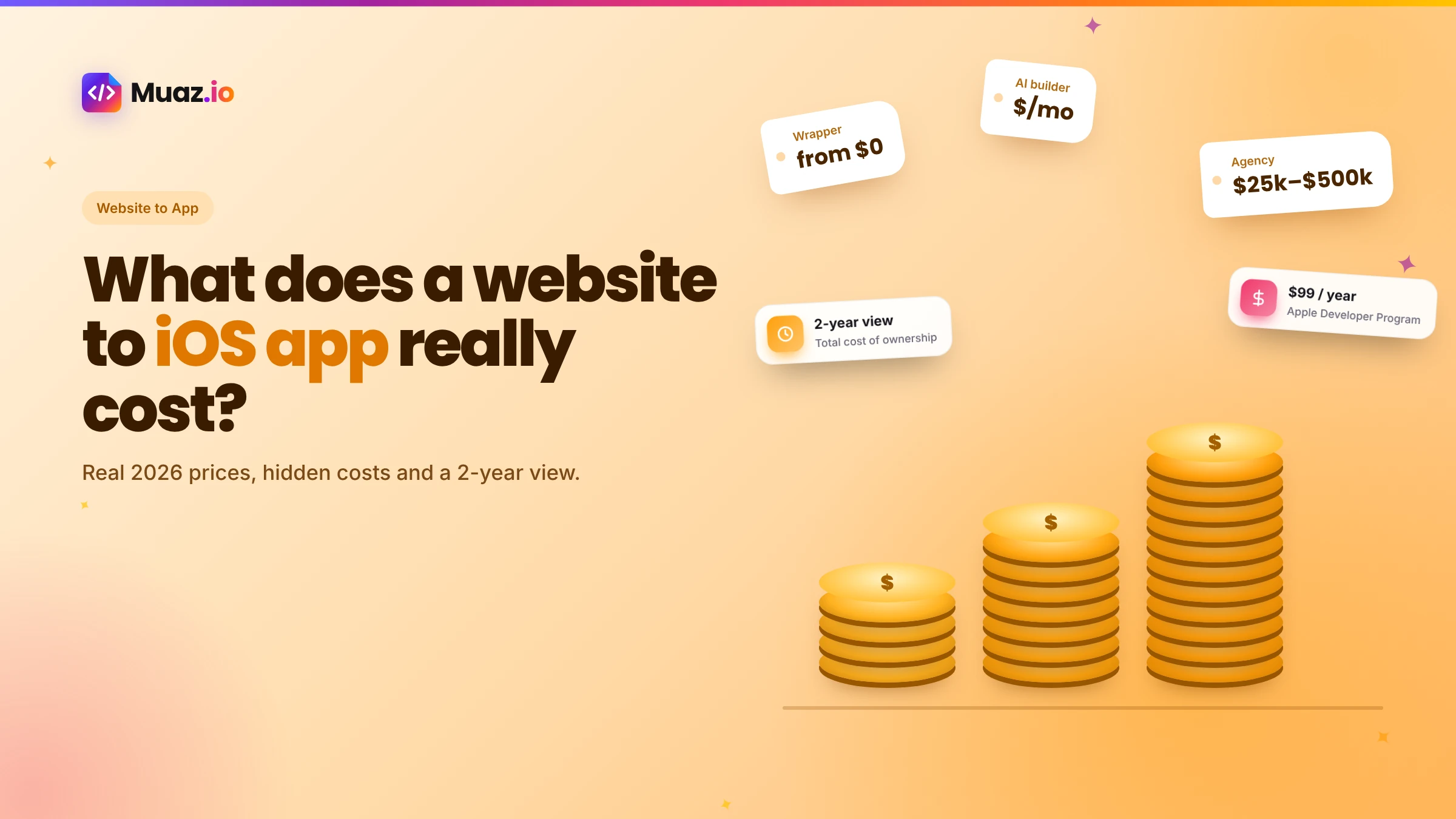 Website to App15 min readHow Much Does It Cost to Convert a Website into a Native iOS App in 2026?
Real 2026 costs for turning a website into an iPhone app: agencies, freelancers, wrappers, no-code and AI builders, plus Apple fees, maintenance and the hidden costs most guides skip.
Monjur Hossain·
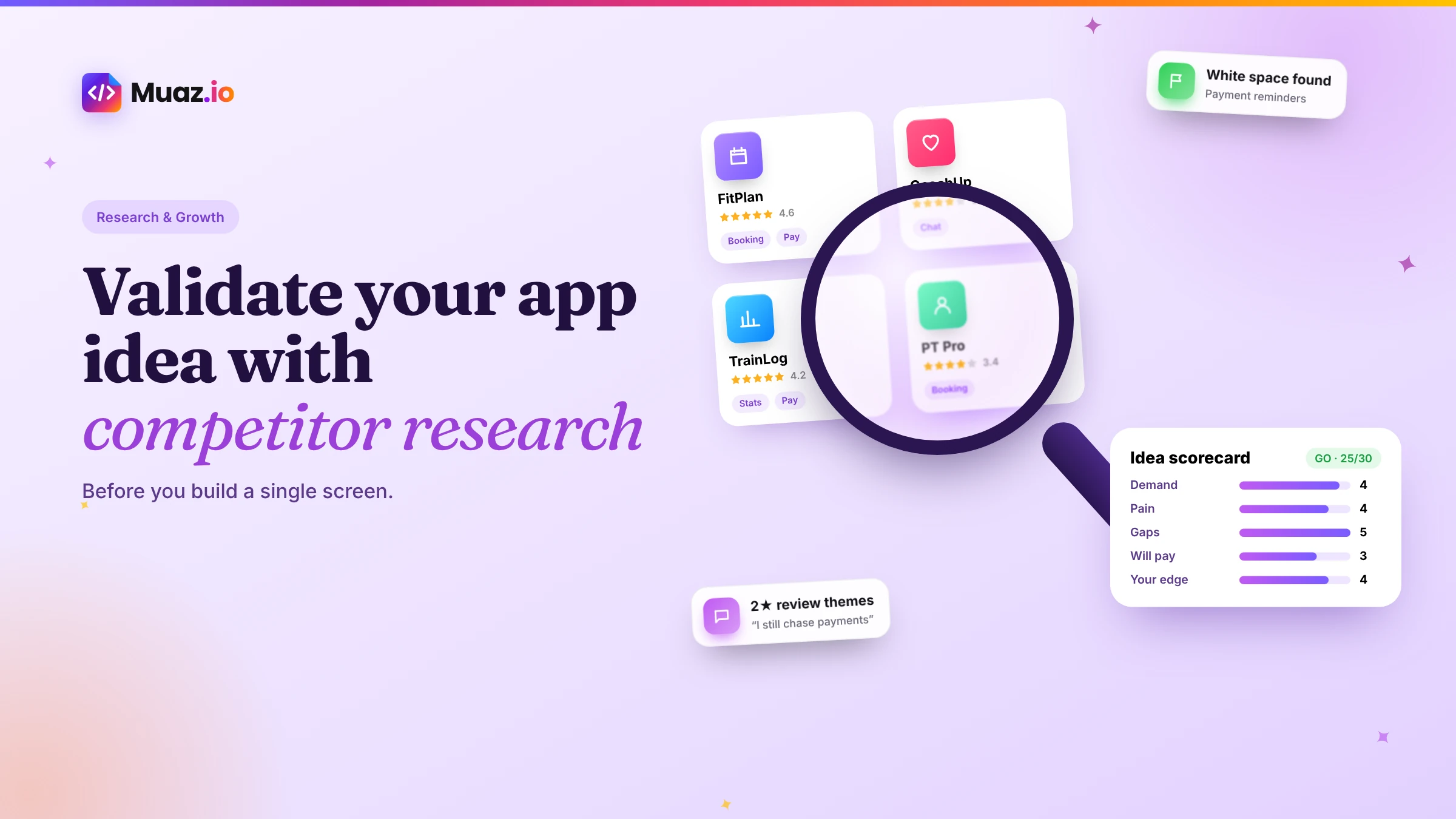 Research & Growth15 min readHow to Validate an App Idea with Competitor Research Before You Build
A practical, step-by-step method to validate an iPhone app idea using competitor apps, App Store reviews, rankings and pricing, so you build something people already want and will pay for.
Monjur Hossain·Related guides and tools
How an AI app builder turns a website, prompt or voice note into a native iPhone app. Research, design, code, testing, App Store launch and growth, explained.
Read the guide Product · 13 min readHow to build an iOS app with AI, from first sentence to App StoreThe 10-step process Muaz.io uses to turn a website or idea into a published iPhone app: research, brief, design, build, testing, App Store launch and growth.
Read the guide Product · 13 min readResearch the apps already winning your categoryResearch the iOS apps winning your category before you design. Screenshots, onboarding, paywalls, pricing and ASO, with licensed estimates clearly labelled.
Read the guide Free tools · 13 min readHow much could your app earn? Model it in a minuteEstimate 12 months of subscription app revenue from downloads, trial and conversion rates, pricing, churn and Apple's commission, using 2026 benchmarks.
Use the free tool Free tools · 13 min readFind an app name people rememberGenerate short, brandable app names that fit Apple's 30-character limit, with subtitle ideas. Free, no sign-up, plus a complete guide to naming an app.
Use the free tool Compare · 13 min readMuaz.io vs Rork: research-first app building vs chat-first app buildingAn honest, sourced comparison of Muaz.io and Rork: native output, competitor research, website-to-app, voice editing, approvals, publishing, growth and pricing.
Read the guideWhere our numbers come from
Third-party figures are estimates published by the sources below. Prices and rules change; check the source before you decide.
- RevenueCat: State of Subscription Apps 2026www.revenuecat.com/state-of-subscription-apps
- TechCrunch: iOS app releases up 80% in Q1 2026techcrunch.com
- Apple Developer Programdeveloper.apple.com/programs
- Apple App Store Review Guidelinesdeveloper.apple.com/app-store/review/guidelines
- Apple Small Business Programdeveloper.apple.com/app-store/small-business-program
Your app is one sentence away.
Paste your site or describe your business. You get competitor research and three original concepts, free.