Muaz.io vs Rork: research-first app building vs chat-first app building
Both build real mobile apps with AI and help you publish them. The difference is where they start: Rork starts with a chat prompt; Muaz.io starts with your market, your website and your approval at every step.
The short answer
Choose Rork if you want to open a chat, describe an app and start building immediately, including on your phone, and you are comfortable deciding the product strategy yourself. Rork's offering covers native Swift apps for Apple devices, Kotlin for Android, web apps, games, a backend, an AI App Store reviewer and screenshot tools.
Choose Muaz.io if you want the app built around evidence: your competitors on the App Store, your existing website and brand, and a written brief you approve. Muaz.io adds approvals and an audit log at every consequential step, voice editing across the lifecycle, a growth studio after launch, agency workspaces and a fully automated App Factory for teams that build many apps.
Both are serious tools. This page explains the differences so you can choose with confidence. We have tried to be fair; where a fact comes from a third party, it is cited.
Compare for yourself in five minutes
Paste the same idea into Muaz.io and see research, design and a live iPhone preview before you choose.
Side-by-side overview
| Muaz.io | Rork | |
|---|---|---|
| Starting point | Website URL, prompt or voice | Chat prompt |
| Market research before design | Yes: 5, 10 or 20 App Store competitors with sourced revenue and download estimates | Not listed |
| Website-to-app ingestion | Yes: pages, brand tokens, flows | Not listed |
| Output | React Native + Expo (native iOS), code you own | Swift for iOS (Max), Kotlin for Android, web |
| Voice editing | Yes, across research, design, build, publish and growth | Not listed |
| Approvals and audit log | Every consequential action | Not listed |
| App Store publishing | Yes, with readiness checklist and your approval | Yes, including an AI App Store reviewer |
| Screenshots | Generated from your real app in required sizes | Screenshot Studio |
| Growth after launch | ASO, experiments, 30/60/90-day plan | Not listed |
| Agency features | Client workspaces, white-label, approvals | Not listed |
| Full autopilot | App Factory: idea to App Review with zero manual steps | Not listed |
| Pricing (Oct 2026) | Free to research and design | Pro from $20/mo, Max from $200 (native.express) |
"Not listed" means we could not find the feature described on Rork's public website at the time of writing. Rork ships quickly, so check their site for the latest.
Where Rork is strong
Rork deserves credit for making native app creation feel immediate. Its public site describes Swift apps for Apple devices and Kotlin apps for Android, a realtime backend with auth and storage, multi-modal AI features for app makers, native games, an AI App Store reviewer to catch rejections early and a one-click screenshot studio. Rork Max is described as building, installing and publishing iOS apps "on the go".
If your priority is the fastest possible path from an idea in your head to code on a device, and you already know exactly what you want to build, Rork is an excellent fit.
Where Muaz.io is different
Research before you build
The biggest risk in a new app is not the code; it is building something people do not choose over the alternatives. Muaz.io starts every project by studying 5, 10 or 20 apps in your category: their screenshots, ratings, pricing, update cadence, keywords and review themes, plus revenue and download estimates from licensed providers when available, always labelled with the source. You save the patterns that inspire you, and the brief explains exactly where your app will be better. Learn more on the competitor research page.
Your website becomes the spec
Most businesses that want an app already have a website. Muaz.io reads it, maps the pages and flows, extracts your brand colours, fonts and tone, and turns them into a mobile screen map. You do not have to describe your business from scratch in a chat box. See website to app.
Voice across the whole lifecycle
In Muaz.io, voice is not a microphone on a chat box. You can research ("compare ten apps like this in the UK"), design ("make the header bolder"), build ("add Face ID"), publish ("draft the subtitle") and grow ("plan a 7-day trial test") by speaking. Every change is transcribed, versioned and reversible. See the voice editor.
Free: AI App Builder Buyer's Scorecard
Compare any AI app builder on 20 criteria that matter after launch, not just in the demo.
We’ll email the resource and a few practical tips. Unsubscribe in one click. We never sell your data.
Approvals and an audit trail
Muaz.io never connects to a live API, spends money, uploads a build or submits for review without an explicit approval, and every agent action is written to an audit log. For founders, that is peace of mind. For agencies and enterprises, it is a requirement. See Muaz.io for enterprise.
Growth is part of the product
Launch is the start. Muaz.io's Growth Studio builds a 30, 60 and 90-day plan from your research, drafts ASO metadata, proposes paywall and onboarding experiments grounded in published benchmarks such as RevenueCat's 2026 subscription research, and tracks results.
Built for teams and agencies
Client workspaces, white-label previews, role-based approvals and per-project credentials make Muaz.io practical for agencies delivering many apps. See Muaz.io for agencies.
Full autopilot when you want it
For teams that build many apps, Muaz.io's App Factory runs all ten steps automatically under an owner's one-time pre-authorisation, with a Design Critic agent that compares every app against top App Store reference apps and redesigns until it clears your quality bar.
Output: React Native vs Swift
Muaz.io generates React Native projects with Expo. React Native renders real native components, so apps get native navigation, gestures, performance and access to Face ID, notifications, widgets and Apple Pay. A single codebase also makes Android and web versions easier later, and the ecosystem of libraries and developers is very large. Rork offers Swift for iOS and Kotlin for Android through separate products. Swift gives the most direct access to new Apple APIs; React Native gives broader reach from one codebase. Both pass App Review when the app offers real native value.
Pricing and value
According to native.express in October 2026, Rork's Pro plan starts at $20 per month and Rork Max from $200. Muaz.io is free for research and design, so you can see your app before paying; paid plans add builds, more research runs and team seats. The more useful comparison is total cost per successful launch: time saved on research and specification, fewer redesigns and App Review rejections and a growth plan from day one.
Who should choose which
Choose Rork if you are a builder who wants to start coding by chat immediately, you want Swift specifically, you build games or you want to build from your phone.
Choose Muaz.io if you want to validate the market first, you already have a website or brand, you want to edit by voice, you need approvals and an audit trail, you are an agency or enterprise or you want growth built in after launch.
Try both with the same idea
The fairest test is to give both tools the same idea and compare the results after a week, not after a demo. Paste your idea or website into the builder at the top of this page and see the research, brief and three design concepts on a live iPhone for free. For a wider view of the market, read the best AI app builders in 2026.
A one-week test plan
To compare fairly, give each tool the same brief and the same amount of your time. On day one, enter the idea and note how much product thinking the tool does for you. On day two, review the design and ask for three changes. On day three, connect a sample API or data source. On day four, install a test build on your iPhone. On day five, prepare the App Store listing. Score each tool on the quality of the app, the clarity of its decisions, how much you had to specify yourself and how ready you feel to launch. The tool that scores best for your situation is the right one.
Questions to ask any AI app builder
Before you commit, ask a few questions that matter after the demo. Do I own the source code, and can I export it at any time? Which actions does the AI take without asking me? How are secrets and API keys stored? What happens when App Review rejects the app? Does the tool help me after launch, with keywords, screenshots and experiments? Can my team work in it with roles and approvals? Download the buyer's scorecard below for the full list of 20 criteria.
Our commitment on comparisons
We update this page when either product changes significantly and cite sources for any claim about another company's product. If you work at Rork and see something inaccurate, email support@muaz.io and we will correct it promptly. Comparisons are only useful when they are fair.
What users usually decide
In our experience, people who already know exactly what they want and enjoy iterating in a chat tend to love chat-first tools. People who want a partner in the product decisions, who have an existing business and brand, or who answer to clients, investors or a security team tend to prefer a research-first, approval-driven pipeline. Many teams use more than one tool over a product's life. What matters is choosing the right one for the decision in front of you today.
A closer look at the research engine
Because research is the biggest difference between the two products, it is worth explaining what Muaz.io's Discovery Engine actually produces. For each competitor it collects the App Store listing details, such as name, subtitle, developer, category, rating and number of ratings, price and in-app purchases, screenshots and update history. It groups recent reviews into themes and shows what users praise and complain about. When a licensed provider is connected, it adds revenue and download estimates with the provider, period and country clearly labelled, and it shows "Unavailable" rather than guessing when no estimate exists. From that, it summarises the patterns: onboarding length, paywall model and trial length, navigation structure and keyword usage. You save the patterns you like as inspiration, never the pixels. The brief then states your positioning against the alternatives. That is a different starting point from a chat prompt, and for many businesses it is the difference between building an app and building the right app.
A closer look at approvals
Approvals are not just a security feature; they are how Muaz.io keeps you in charge of a team of agents. At the brief, you approve what will be built. At the design, you approve how it looks. At the backend connection, you approve which systems it touches. At upload and submission, you approve what goes to Apple under your account. During growth, you approve each experiment. Every approval is recorded with who approved and when. For a solo founder that might feel like a few extra clicks; for a team, an agency or an enterprise, it is what makes AI-built apps acceptable to clients, managers and security reviewers.
A closer look at code and ownership
Muaz.io generates a React Native project with Expo, organised into screens, components, navigation, state and a typed API layer, with design tokens in one place. You own it from the first build, can sync it to your repository and can hand it to any React Native developer. Secrets stay on the server and never ship inside the app. If you ever stop using Muaz.io, you keep the code, the design and the App Store listing. Ownership matters more than it seems at the start: it determines who can maintain the app, how easily you can raise investment and whether you can switch tools without starting over.
A closer look at growth
The Growth Studio is where Muaz.io keeps working after launch. It drafts your ASO metadata from the research, proposes screenshot and paywall experiments using published benchmarks, schedules re-engagement notifications that users opt into and builds a 30, 60 and 90-day plan with targets. Each experiment needs your approval and reports results when they are clear. Launching is the moment most app builders stop helping; for most apps, it is the moment the real work starts.
Scenario comparisons
A salon owner with a website. She wants clients to book, get reminders and pay deposits. With a chat-first tool, she describes the app and iterates on the result. With Muaz.io, she pastes her website; the agents map her services and prices, research ten salon apps, notice that most competitors bury booking behind sign-up and propose guest booking with Apple Pay deposits. She approves the brief and picks a design. For a business owner without product experience, the research and brief do much of the thinking for her.
A developer building a game. He wants to prototype a puzzle game quickly and is comfortable reading code. Rork's games product and chat-first flow suit him well. Muaz.io can build game-like apps but is optimised for business and consumer apps rather than game engines.
An agency with five clients. The agency needs separate workspaces, client approvals, white-label previews and an audit trail. Muaz.io is built for this workflow; with a chat-first tool, the agency would need to manage those processes outside the product.
A startup testing a subscription idea. The founder needs to know whether the market can support the app before building. Muaz.io's research shows competitors' pricing, ratings and review themes, and the revenue calculator models the economics. A chat-first tool gets a prototype into hands quickly; the founder would do the market research separately.
An enterprise team with security requirements. SSO, approval policies, scoped keys and audit logs are central to Muaz.io's enterprise offering. Teams should review any vendor's enterprise controls directly before adopting.
Migration paths
If you already built an app with another tool and want to try Muaz.io, start by pasting your app's website or App Store listing details into the builder. The research engine will compare your app with its competitors, and the design engine will propose an improved version on your brand. Code is not imported automatically between platforms, but your App Store listing can be kept by publishing the new version as an update to the same app record, preserving your ratings and reviews.
Strengths summary
Rork's strengths: fast chat-first building, Swift for iOS and Kotlin for Android, native games, phone-based creation, a realtime backend, an AI App Store reviewer and one-click screenshots.
Muaz.io's strengths: research-first strategy with 5, 10 or 20 competitors and sourced revenue intelligence, website-to-app ingestion of your brand and flows, three original concepts on a live iPhone, voice editing across every stage, approvals and an audit log for every consequential action, a growth studio after launch, agency and enterprise workspaces and a full-autopilot App Factory.
Final verdict
If you know exactly what to build and want to start coding by conversation, Rork is a great choice. If you want the app built around your market and your brand, with a partner in the product decisions and control at every step, Muaz.io is built for you. Try Muaz.io's free research and design with your own idea, compare the result and choose the tool that gets you to a successful launch fastest.
Glossary for this comparison
Chat-first. A builder where you start by describing the app in a conversation and iterate on the generated result.
Research-first. A builder that analyses the market and competitors before designing or generating code.
React Native. A framework that builds native iOS and Android apps from one JavaScript and TypeScript codebase using native components.
Swift. Apple's programming language for native iOS, iPadOS and macOS apps.
Approval gate. A checkpoint where a human must approve before an AI agent can continue.
Audit log. A record of every action, who took it and who approved it.
Ready to compare? Paste your idea in the builder above.
It is free to start.
Start now.
Still have questions about rork alternative? Ask the assistant inside the Muaz.io builder. It knows your project, your competitors and every source cited in this guide, and it answers in plain language.
Questions about muaz.io vs rork
Short, direct answers. Still curious? Ask in the builder; the assistant knows your project.
Is Rork a good app builder?
Yes. Rork is a capable AI app builder that generates native apps, including Swift apps for Apple devices and Kotlin apps for Android, with publishing, a backend and an App Store review helper. If you want to start from a chat prompt and build quickly, it is a strong option.
What does Muaz.io do that Rork does not?
Muaz.io is built around a research-first pipeline: it analyses 5, 10 or 20 App Store competitors with revenue intelligence before designing, converts an existing website into an app, lets you edit by voice across the whole lifecycle, requires approvals at every consequential step with an audit log, and includes a growth studio, agency workspaces and a fully automated App Factory.
Which is cheaper?
According to native.express in October 2026, Rork's Pro plan starts at $20 per month and Rork Max from $200. Muaz.io is free to research and design, with paid plans for builds and team features. The right comparison is cost per launched, successful app, which depends more on fit than on list price.
Does Muaz.io build in Swift?
Muaz.io generates React Native and Expo projects, which compile to native iOS apps with native navigation, gestures and device features. Rork offers Swift for iOS through Rork Max. Both approaches produce real native apps; React Native also makes Android and web versions easier later.
Can I move from Rork to Muaz.io?
Yes. Paste your existing app's website or describe it, and Muaz.io's research and design engines will propose an improved version. Code is not automatically imported between platforms.
Which one is better for agencies?
Muaz.io, because it includes client workspaces, role-based approvals, white-label previews and an audit trail designed for client work.
Guides on this topic
 Tools & Comparisons16 min read10 Best AI iOS App Builders in 2026: Features, Pricing & Native Support
We compared 10 AI app builders specifically for iPhone apps: native output, App Store publishing, code ownership, design quality and 2026 pricing, with honest picks by use case.
Monjur Hossain·
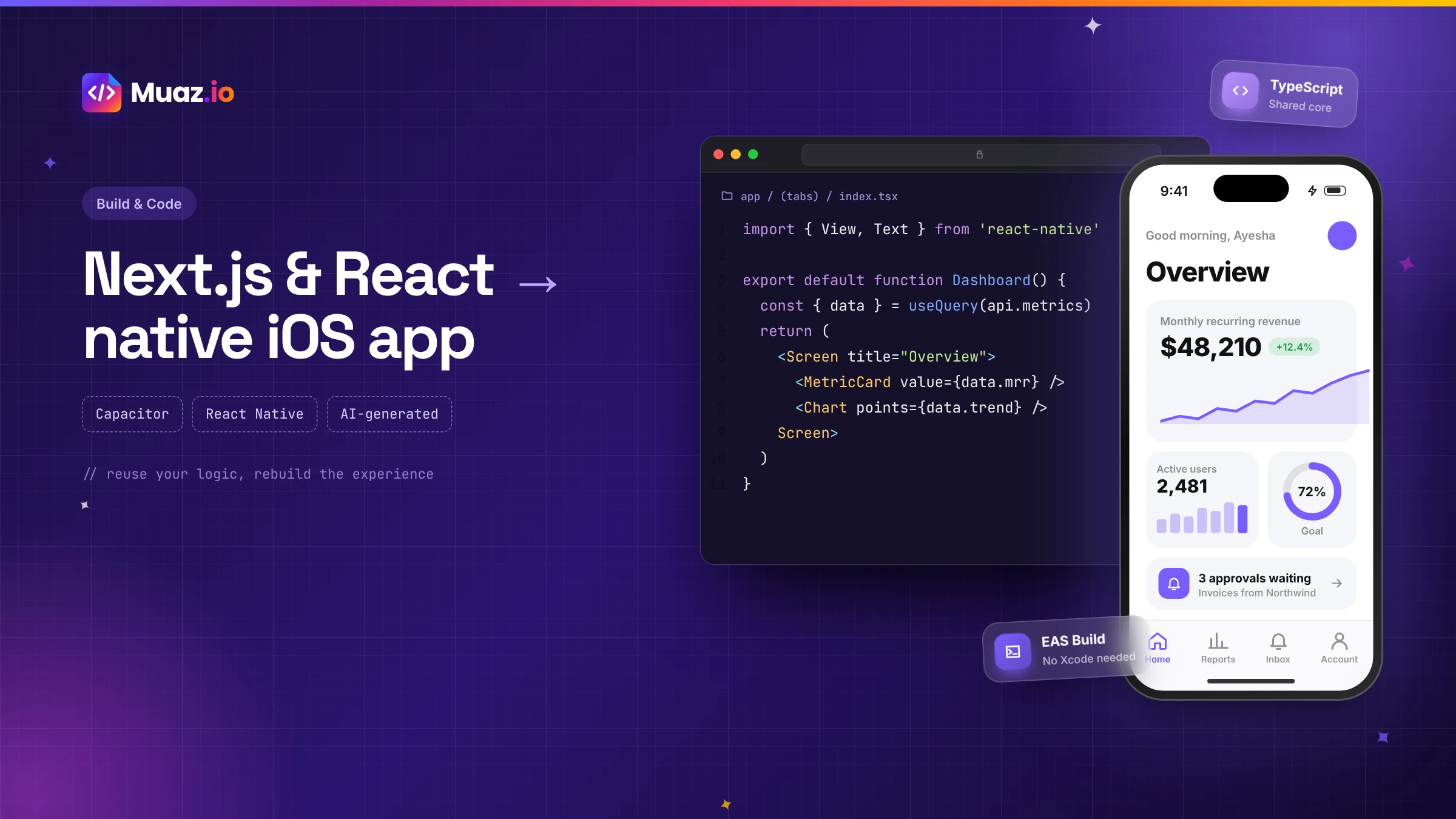 SaaS & Web Apps15 min readHow to Convert a Next.js or React Web App into a Native iOS App
Three proven ways to turn a Next.js or React web app into an iPhone app: Capacitor with a static export, a React Native rebuild sharing your logic, or an AI-generated native app. Pros, cons and steps.
Monjur Hossain· Tools & Comparisons15 min readRork vs FlutterFlow vs Adalo: Which AI App Builder Is Best in 2026?
A fair, sourced comparison of Rork, FlutterFlow and Adalo for building iPhone apps in 2026: how each works, output, publishing, code ownership, learning curve and pricing, plus who should pick which.
Monjur Hossain·Related guides and tools
A sourced comparison of the best AI app builders for iPhone apps in 2026: Muaz.io, Rork, FlutterFlow, Lovable, Bolt, Adalo, Bubble, Thunkable and Median.
Read the guide Compare · 13 min readMuaz.io vs FlutterFlow: an AI team that builds for you vs a visual builder you driveCompare Muaz.io and FlutterFlow on how apps are built, AI depth, competitor research, code ownership, publishing, team workflows and 2026 pricing.
Read the guide Compare · 13 min readMuaz.io vs Median: rebuild your website as a native app, or package it as oneCompare Muaz.io and Median.co for turning a website into an iPhone app: native screens vs web content, App Review risk, features, pricing and ownership.
Read the guide Product · 13 min readResearch the apps already winning your categoryResearch the iOS apps winning your category before you design. Screenshots, onboarding, paywalls, pricing and ASO, with licensed estimates clearly labelled.
Read the guide Product · 13 min readTurn your website into a native iPhone appConvert your website into a native iPhone app with AI. Muaz.io reads your brand, pages and flows, then builds real native screens, not a WebView wrapper.
Read the guide Guide · 13 min readThe AI app builder that researches, designs, builds and launches your iPhone appHow an AI app builder turns a website, prompt or voice note into a native iPhone app. Research, design, code, testing, App Store launch and growth, explained.
Read the guideWhere our numbers come from
Third-party figures are estimates published by the sources below. Prices and rules change; check the source before you decide.
- Rork official websiterork.com
- Apple App Store Review Guidelinesdeveloper.apple.com/app-store/review/guidelines
- Expo documentationdocs.expo.dev
- RevenueCat: State of Subscription Apps 2026www.revenuecat.com/state-of-subscription-apps
Your app is one sentence away.
Paste the same idea into Muaz.io and see research, design and a live iPhone preview before you choose.