25 Best App Marketing Channels in 2027 (Ranked by ROI, Cost & Growth Potential)
Every channel worth your time in 2027, scored on return, cost to start and growth ceiling. See which eight cost nothing but effort, when paid ads start paying back, and exactly how to split a small budget.
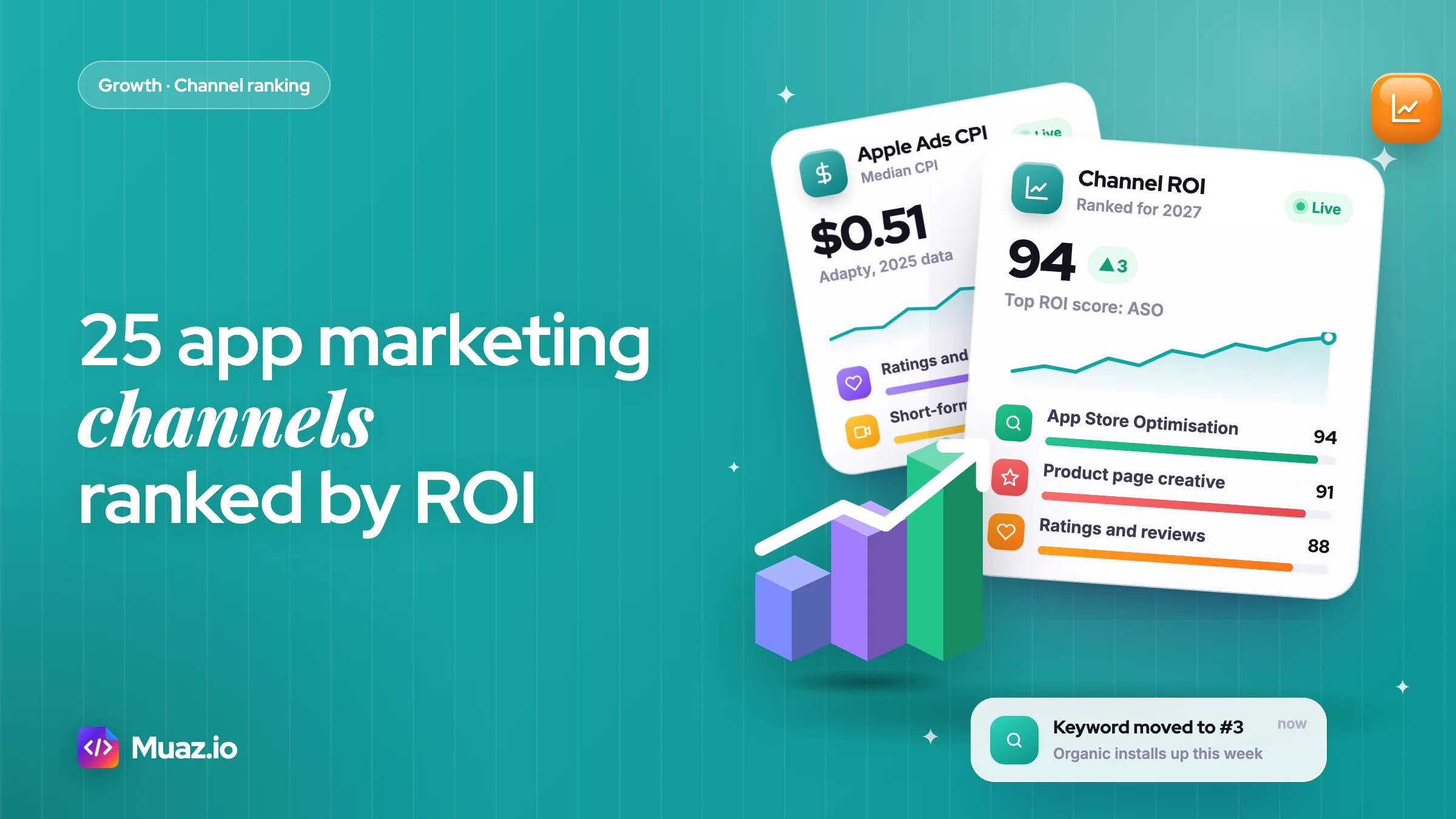
For most new apps the best channel is the App Store itself: keyword optimisation, product page creative and ratings. Apple says almost 65% of downloads happen directly after a search, so a well-optimised listing is free, compounds over time and makes every paid or social channel convert better.
- ASO, product page creative, ratings, short-form video, Reddit, custom product pages, in-app events and email all need effort rather than cash.
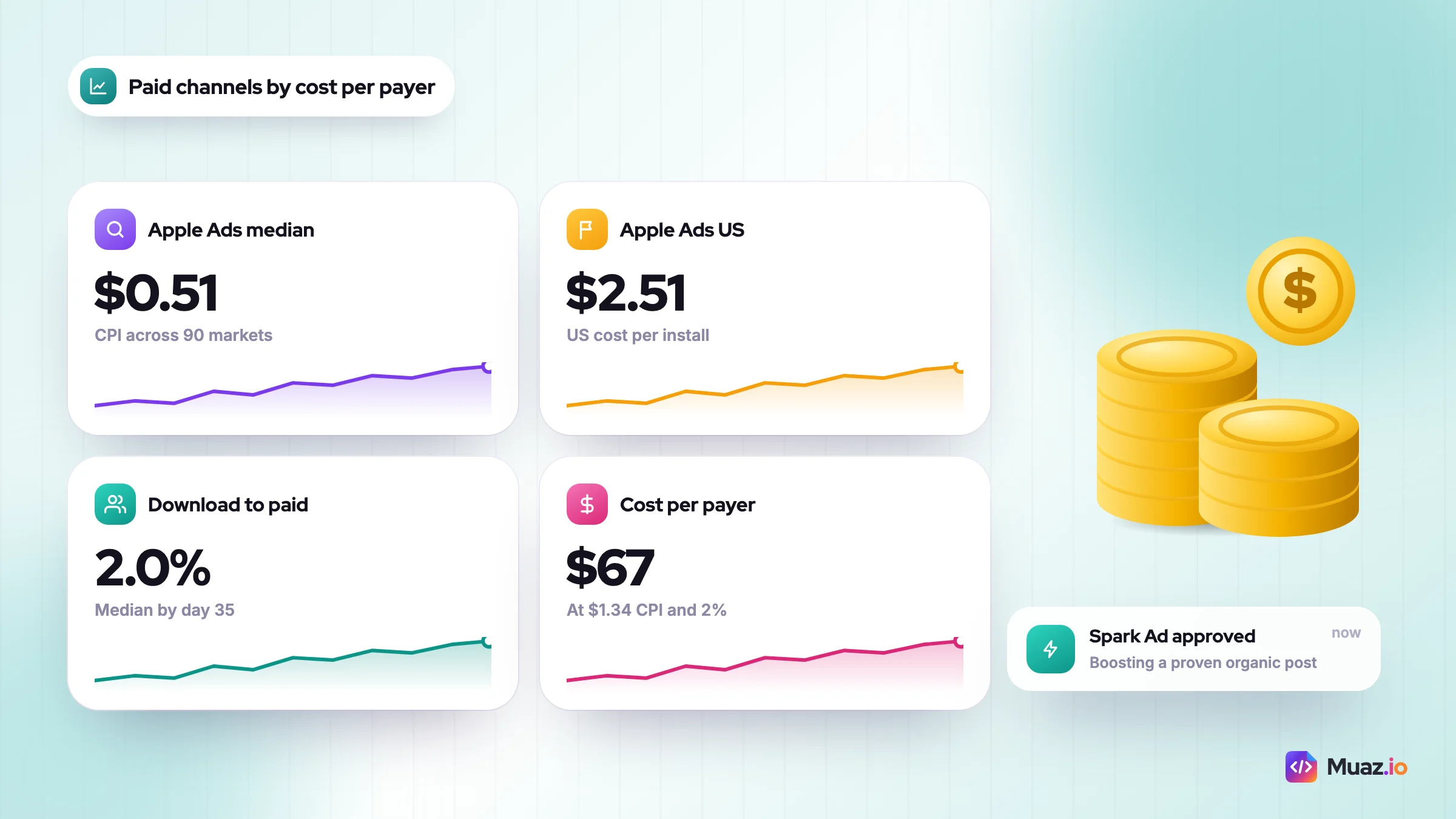
- Adapty's 2025 data puts the median Apple Ads cost per install at $0.51 across 90 markets and $2.51 in the US.
- RevenueCat reports a 2.0% median download-to-paid conversion, so at $1.34 per install each payer costs around $67 in ads.
- Add cash spend and your hours at a fair hourly rate, then divide by the number of payers that channel produced by day 30.
Here is a first marketing plan of the kind founders send me all the time, for a new budgeting app. It lists nineteen channels. TikTok, Reddit, Product Hunt, Apple Ads, Meta, a podcast tour, a referral scheme, an influencer list, a newsletter, a blog, and more. The team has six weeks, two founders and about $2,000.
Nineteen channels with that budget means nineteen half-finished experiments and no clear signal from any of them. The problem was never a lack of ideas. It was the order.
This guide ranks the 25 best app marketing channels for 2027 by three things that decide whether a channel is worth your next hour or your next dollar: return on investment, cost to start, and how far it can grow. You get the full ranking, a comparison table, the numbers behind the paid channels, budget splits for each stage and a scoring sheet you can copy. If you want the whole strategy around channel choice, start with the pillar guide on how to market an app in 2027 and come back here to pick your mix.
How I ranked these app marketing channels
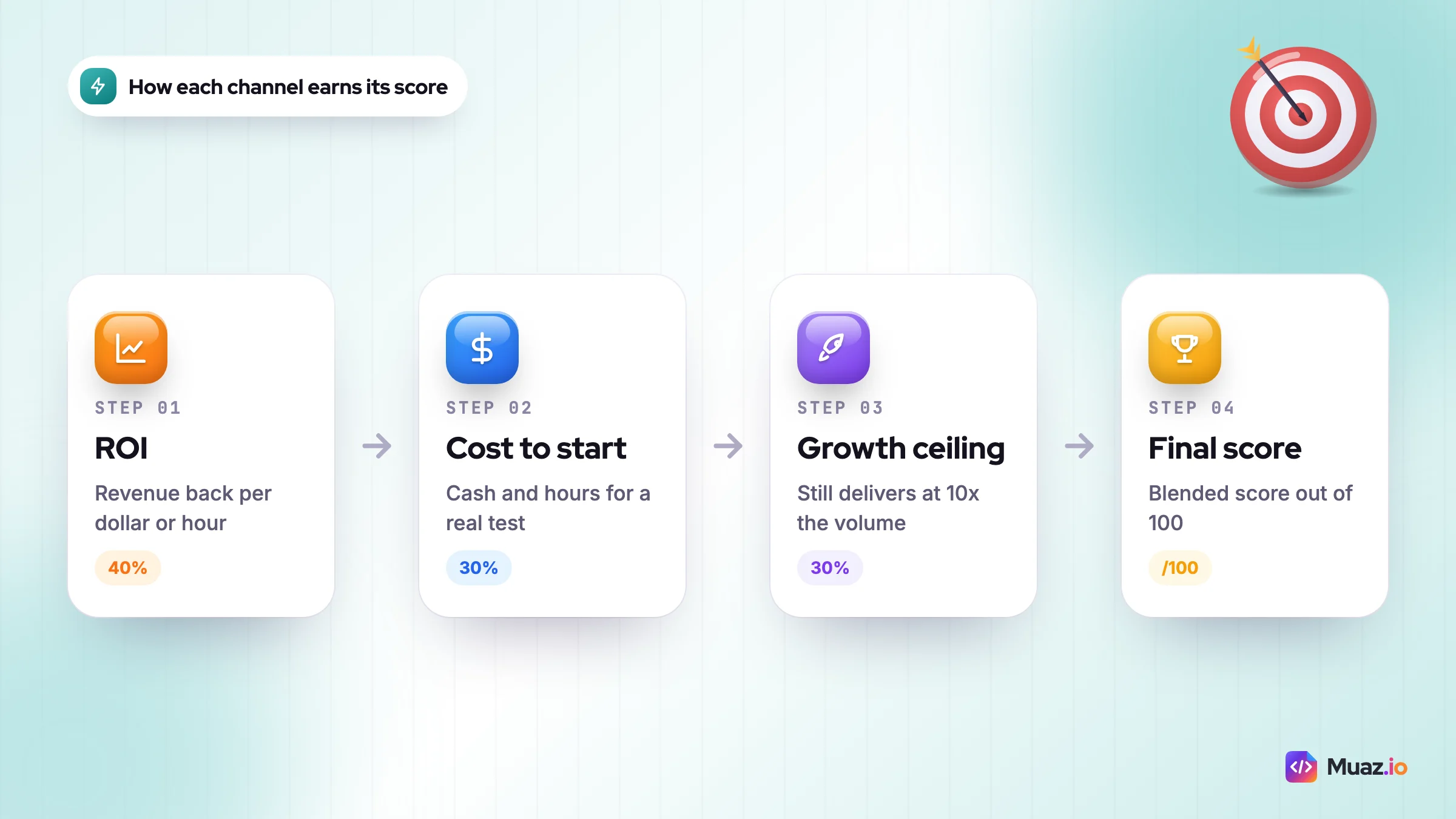
Each channel gets a score out of 100 that blends expected ROI, the cash and time needed to start, and the ceiling on growth once it works. It is a framework score, not a measured benchmark, and it assumes a small team launching a consumer iPhone app with a subscription or in-app purchase.
Here is the weighting I used:
- ROI (40%): how much revenue a typical small app can expect back per dollar or hour, based on published benchmarks where they exist and my own campaign experience where they do not.
- Cost to start (30%): cash needed for a meaningful test, plus the hours. Free channels that eat 20 hours a week do not score as "free".
- Growth potential (30%): whether the channel can still deliver at 10 times the volume, or whether it tops out after a launch spike.
Two caveats. First, your category changes everything. A finance app pays far more per install on paid search than a photo utility does, and a game lives or dies on creative testing in a way a B2B tool does not. Second, channels compound. ASO makes every paid click convert better, and a strong review score makes every TikTok viewer more likely to install. So read the ranking as "where to start", not "where to stop".
The 25 best app marketing channels at a glance
This is the full app marketing channel comparison. Cost bands: Free means time only, $ means under $500 a month for a real test, $$ means $500 to $3,000, $$$ means more than $3,000.
| Rank | Channel | Type | Cost to start | Time to first results | ROI score |
|---|---|---|---|---|---|
| 1 | App Store Optimisation (keywords) | Organic, store | Free | 2 to 6 weeks | 94 |
| 2 | Product page creative | Organic, store | Free | Days | 91 |
| 3 | Ratings and reviews | Organic, store | Free | 2 to 4 weeks | 88 |
| 4 | Organic short-form video | Organic, social | Free | 2 to 8 weeks | 86 |
| 5 | Reddit and niche communities | Organic, community | Free | Days | 84 |
| 6 | Apple Ads (search results) | Paid, store | $ | Days | 82 |
| 7 | Custom product pages | Organic and paid, store | Free | 1 to 3 weeks | 80 |
| 8 | In-app events | Organic, store | Free | 1 to 2 weeks | 78 |
| 9 | Referral programme | Owned, viral | $ | 4 to 8 weeks | 76 |
| 10 | Email list and waitlist | Owned | Free to $ | Launch day | 75 |
| 11 | Micro-influencers | Partnerships | $ to $$ | 2 to 6 weeks | 73 |
| 12 | Build in public | Organic, social | Free | 1 to 3 months | 71 |
| 13 | SEO and web content | Organic, web | Free to $ | 3 to 6 months | 69 |
| 14 | AI answer engines | Organic, web | Free | 1 to 4 months | 67 |
| 15 | App Store featuring nominations | Organic, store | Free | 2 weeks to 3 months | 65 |
| 16 | Product Hunt | Launch platform | Free | Launch day | 62 |
| 17 | Cross-promotion and partnerships | Partnerships | Free | 2 to 8 weeks | 60 |
| 18 | Google App Campaigns | Paid | $$ | 2 to 4 weeks | 58 |
| 19 | TikTok Ads and Spark Ads | Paid, social | $$ | 1 to 3 weeks | 57 |
| 20 | Meta Ads (Facebook, Instagram) | Paid, social | $$ | 2 to 4 weeks | 55 |
| 21 | Google Play custom store listings | Organic, store | Free | 1 to 3 weeks | 52 |
| 22 | Launch directories | Launch platform | Free to $ | Days | 48 |
| 23 | PR and app review sites | Earned media | Free to $$$ | 2 to 8 weeks | 45 |
| 24 | Podcast and YouTube sponsorships | Paid, creators | $$ to $$$ | 4 to 8 weeks | 42 |
| 25 | Incentivised installs and offerwalls | Paid | $$ | Days | 25 |
Notice the pattern. Eight of the top ten cost nothing but time, and five of them live inside the App Store itself. That is not because paid channels are bad. It is because paid traffic lands on your product page, and a weak page burns money whatever the ad platform.
What is the best marketing channel for an app?
For most new apps the best marketing channel is the App Store itself: keyword optimisation, product page creative and ratings, because they are free, they compound, and they improve every other channel you add later.
Apple says 70% of App Store visitors use search to discover apps and almost 65% of downloads happen directly after a search (2022 figures), according to its Apple Ads overview. The same page puts weekly App Store visitors at more than 850 million. If two thirds of installs start with a search box, the search box deserves your first week.
After the store, the best second channel depends on where your users already spend attention. Visual consumer apps tend to win on short-form video. Niche tools and hobby apps tend to win on Reddit and communities. Apps with clear, high-intent search terms ("pdf scanner", "macro tracker") tend to win on Apple Ads. Pick one of those three as your second channel, not all of them.
Channels 1 to 5: the free foundations
1. App Store Optimisation (keywords)
ASO is the work of matching your app name, subtitle and keyword field to the words people actually type. On the App Store you get a 30-character name, a 30-character subtitle and a 100-character keyword field, and every character counts. Score: 94.
What I would do: list 50 candidate terms, cut anything where the top five results are giant brands, then put your best two-word phrase in the subtitle rather than wasting the name on a tagline. Our complete ASO guide for 2027 walks through the full method, and the free ASO keyword tool will draft a name, subtitle and keyword field for you in a minute.
2. Product page creative
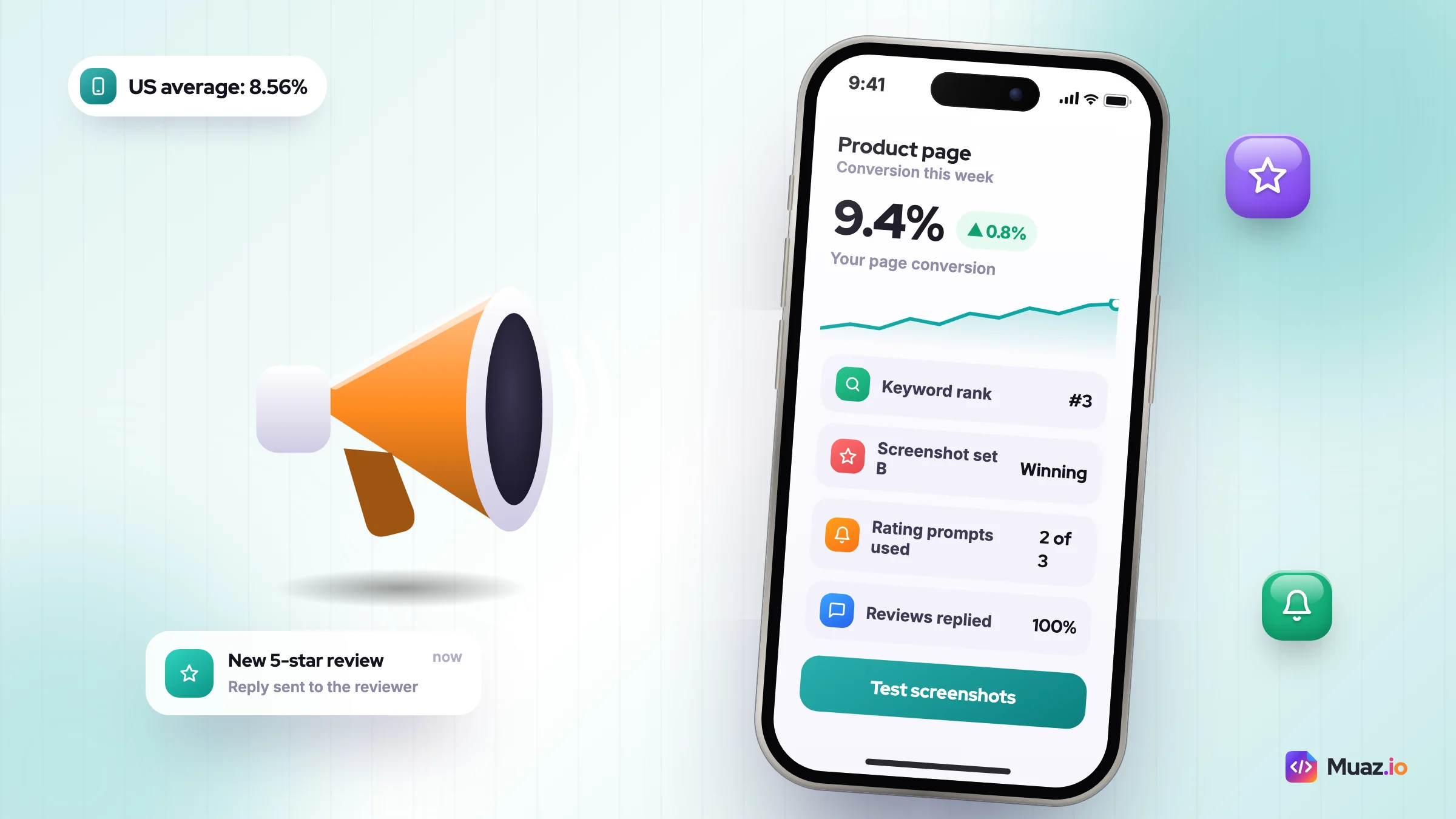
Keywords get you seen. Screenshots, icon and preview video get you installed. AppTweak found the average conversion rate in the US App Store was 8.56% in 2025, against 16.15% on US Google Play, with huge spreads by category, in its conversion rate benchmarks by category. Score: 91.
The fix is usually simple. Lead with the outcome, not the menu. Your first screenshot should answer "what do I get?" in under five words, such as "Budget in 2 minutes a week", with the actual screen underneath. The free screenshot generator exports every required iPhone and iPad size so you can test new sets quickly.
3. Ratings and reviews
Ratings act as a conversion multiplier on every channel. Apple lets you show the system rating prompt up to three times in a 365-day period and advises asking right after a user completes a task, according to its ratings and reviews guidance. You can also reply to any review in App Store Connect, and the reviewer is notified. Score: 88.
Trigger the prompt after a win: the third completed workout, the first exported document, the first saved budget. Never after an error, a paywall or on first launch.
4. Organic short-form video
TikTok, Instagram Reels and YouTube Shorts are the strongest free channel outside the store for any app you can show working in five seconds. The format rewards a hook, a visible result and a reason to care, and it does not need a follower count to start. Score: 86.
The trap is posting polished ads. Native, slightly rough clips of a real person using the app ("I stopped overspending with this one rule") beat brand-style edits almost every time. Plan three formats, post daily for 30 days and double down on whichever format earns saves and profile visits. The full playbook lives in our guide to TikTok, Reels and Shorts for app growth.
5. Reddit and niche communities
Reddit reported 130.3 million daily active uniques and 514.6 million weekly active uniques in the second quarter of 2026, according to its Q2 2026 results. More useful than the scale is the structure: thousands of communities organised around exact problems your app might solve. Score: 84.
Reddit punishes promotion and rewards help. Spend two weeks answering questions in three or four subreddits before you mention your app, read each community's rules, and when you do share it, share the story of why you built it and ask for blunt feedback. Our Reddit marketing guide for apps has post templates that respect the rules.
Channels 6 to 10: store power tools and owned audiences
6. Apple Ads (search results)
Apple Ads (formerly Apple Search Ads) is the highest-ranked paid channel here because it catches people at the moment of intent, inside the store. Apple reports a tap-through install rate of over 60% for ads at the top of search results, measured across all Apple Ads markets from November 2024 to October 2025. Score: 82.
Costs are lower than many founders expect. Adapty's Apple Ads benchmarks, drawn from 2025 data on more than 8,000 apps, put the median cost per install across 90 markets at $0.51, the spend-weighted average at $1.34 and the US figure at $2.51. Start with exact-match campaigns on your own brand and five to ten high-intent generic terms, set a daily cap you can afford to lose, and judge by trial starts, not installs. For a head-to-head on budgets and targeting, read Apple Ads vs Google App Campaigns vs Meta Ads.
7. Custom product pages
You can publish up to 70 additional versions of your App Store product page, and Apple now lets you assign keywords so a custom page appears in search results for those terms, per its custom product pages documentation. That makes each page a free landing page tuned to one audience or one ad. Score: 80.
Example: say you run a habit-tracking app. One page leads with "Quit sugar" screenshots for a TikTok campaign about cravings, another with "Morning routine" for a Reels creator, and a third targets the keyword "water reminder". Same app, three pitches, each matched to the promise the visitor just saw.
8. In-app events
In-app events put a time-limited card on your product page, in search results and in editorial selections. An event can last up to 31 days and be promoted up to 14 days before it starts, and you can have up to 10 published at a time, per Apple's in-app events guide. Score: 78.
Use them for anything with a date: a 30-day challenge, a new feature, a seasonal theme. They also give lapsed users a reason to come back, which is a cheap win for retention.
9. Referral programme
A good referral programme turns your happiest users into a channel with almost no marginal cost. It scores lower than the store channels only because it needs existing users and a reward that people actually want. Score: 76.
Two-sided rewards work best: "Give a friend a free month, get a free month." Ask at a moment of delight, make the share link one tap, and track invites sent per active user. If fewer than 5% of active users ever send an invite, fix the moment or the reward before you promote it.
10. Email list and waitlist
An email list is the only audience no algorithm can take from you. Before launch, a simple waitlist page gives you a group of people who will install on day one, which is exactly the burst of early downloads and reviews the store responds to. Score: 75.
Keep it plain: a one-line promise, one screenshot, one field. Send a short update every two weeks with something real (a screen, a decision you made, a question), then send a launch email with the App Store link and a direct request for an honest rating.
Channels 11 to 15: creators, content and discovery
11. Micro-influencers
Creators with 5,000 to 100,000 followers often beat large accounts on cost per install because their audiences trust them and their rates are negotiable. They also produce content you can reuse as ads, which makes the spend work twice. Score: 73.
Start with ten creators who already post about your problem, offer a flat fee plus a free lifetime account, and give each a tracked link or custom product page. Ask for raw footage rights so you can run the best clip as a Spark Ad later. Our micro-influencer marketing guide includes an outreach script and rate ranges.
12. Build in public
Sharing your progress on X, LinkedIn and Indie Hackers builds an audience before you have a product to sell. It is slow, and it works best for apps whose buyers are founders, developers or other makers. Score: 71.
Post one concrete number or decision per day: a screenshot of your onboarding test, your first week of revenue, a feature you cut and why. People follow stories, not announcements.
13. SEO and web content
A website that ranks for problem-led searches ("how to stop impulse buying") sends steady, high-intent visitors to your App Store page for years. It is slow to start, so it scores mid-table for a launch but very high for year two. Score: 69.
Write one genuinely useful page per core problem your app solves, add a smart app banner, and link to a custom product page that matches the page topic.
14. AI answer engines
More people now ask ChatGPT, Gemini or Perplexity "what's the best app for X" before they ever open the store. These assistants lean on pages that state clear facts, comparisons and reviews, so the same content that ranks in search tends to get you cited in answers. Score: 67.
Publish a plain comparison page for your category, make sure your app's name, price and key features appear in consistent words across your site, store listing and directories, and earn mentions on the review sites assistants already cite. The detail is in our guide to app discoverability on ChatGPT, Gemini and Perplexity.
15. App Store featuring nominations
Apple's editors pick featured apps partly from nominations submitted in App Store Connect. Apple asks for at least two weeks' notice and recommends nominating up to three months ahead for wider consideration, per its getting featured page. Score: 65.
It scores lower only because you cannot control the outcome. Nominate every launch, major update and in-app event anyway. It costs ten minutes, and a single feature can outsell a month of ads.
Free: App Channel Scoring Sheet (2027)
A copyable spreadsheet that scores each marketing channel by total cost, payers and cost per payer so you know what to scale, fix or stop.
We’ll email the resource and a few practical tips. Unsubscribe in one click. We never sell your data.
Channels 16 to 20: launch platforms and paid scale
16. Product Hunt
Product Hunt gives you one big day of attention from early adopters, plus a permanent listing and a backlink. Its official launch guide is clear that you cannot ask people directly to upvote, and suggests 12:01 am Pacific Time for makers who plan ahead. Score: 62.
It works best for productivity, AI and developer tools, and much less for consumer lifestyle apps. Treat it as one stop on a launch week rather than the launch itself. Our guide on where to launch an app covers Product Hunt and 20 other platforms.
17. Cross-promotion and partnerships
Find two or three apps or newsletters that serve your audience without competing with you, and swap placements: a mention in their onboarding, a feature in their email, a co-branded challenge. It costs nothing but negotiation. Score: 60.
18. Google App Campaigns
Google App Campaigns run across Search, Play, YouTube and the Display network from one setup, with Google's machine learning choosing placements. They can scale fast for Android, but they need enough conversion data to learn, so small budgets often stall. Score: 58.
Optimise for an in-app action (trial start, purchase) rather than installs as soon as you have the volume, and feed the campaign several videos and image sizes.
19. TikTok Ads and Spark Ads
Spark Ads let you pay to boost organic posts, either your own or a creator's, so the ad keeps its likes and comments. TikTok's app promotion page cites Adjust data (US, May 2022 to August 2023) claiming 39% lower uninstall rates for TikTok-driven installs than other platforms. Treat a platform's own numbers as a starting claim to test, not a promise. Score: 57.
The rule I follow: only boost posts that already proved themselves organically. Paying to push an unproven ad is how TikTok budgets disappear.
20. Meta Ads (Facebook, Instagram)
Meta still has the deepest targeting and the most mature app install products, and for many subscription apps it remains the largest paid channel at scale. For a brand-new app on a small budget it is harder: you need tested creative, a working event setup and patience through the learning phase. Score: 55.
Channels 21 to 25: situational and last resort
21. Google Play custom store listings
On Android you can create up to 50 custom store listings and target them by country, by ads traffic and search keywords, and by user behaviour such as churned or lapsed users, according to the Google Play Console help. It ranks low here only because this guide assumes an iPhone-first app. If Android is your main platform, move it into your top ten.
22. Launch directories
Sites such as BetaList, Indie Hackers' product directory and the many "new app" lists bring a trickle of early adopters and a few backlinks. Submit to the five most relevant in an afternoon and move on. Score: 48.
23. PR and app review sites
Coverage in a major tech outlet is rare for a new app, and a paid PR agency rarely pays back at launch. Niche bloggers and newsletters in your category are a better bet: pitch a story ("a nurse built this shift-planning app after three burnt-out years"), not a press release. Score: 45.
24. Podcast and YouTube sponsorships
Host-read sponsorships can work well for apps with a clear audience match, such as a finance app on a personal finance podcast. They are expensive, slow to book and hard to attribute, so leave them until your paid funnel is proven. Score: 42.
25. Incentivised installs and offerwalls
Paying users in points or credits to install your app produces cheap installs and almost no paying customers. It can lift chart positions for a day or two, but those users rarely open the app twice, and the inflated numbers make every other channel harder to read. Outside some gaming strategies, I would skip it entirely. Score: 25.
Organic vs paid app marketing: which should you start with?
Start organic, then add paid once your product page converts and you know what a paying user is worth. Paid traffic amplifies whatever you already have, so it makes a good funnel better and a weak funnel more expensive.
The economics make the case. RevenueCat's State of Subscription Apps 2026 puts the global median download-to-paid conversion at 2.0% by day 35, rising to 10.7% for hard paywalls against 2.1% for freemium. Run the numbers for an example app: at a 2% conversion and a $1.34 cost per install, each paying user costs about $67 in ad spend. If your first-year revenue per payer sits near RevenueCat's $23 median, paid installs lose money until you raise conversion or price.
| Factor | Organic channels | Paid channels |
|---|---|---|
| Cash needed | Close to zero | $500 to $3,000 a month for a fair test |
| Speed | Weeks to months | Days |
| Predictability | Low at first, compounds over time | High once tuned |
| User quality | Usually higher intent | Varies widely by network and creative |
| Learning value | Tells you which message resonates | Tells you what a user costs |
| Stops when you stop | No, assets keep working | Yes, immediately |
The best mix uses both: organic tells you which message works, and paid buys more of it. Your winning TikTok becomes your Spark Ad, your best-converting screenshot set becomes the default page, your highest-intent keyword becomes an Apple Ads exact match.
Which app marketing channels are best for startups on a low budget?
With under $500 a month, put your time into ASO, product page creative, review prompts, one content channel and one community, and spend any cash on a small Apple Ads exact-match test.
These are the low cost app marketing channels I would pick, in order, for app promotion for startups with no team:
- Fix the store listing first: keywords, first three screenshots, and a rating prompt after the first win.
- Pick one content channel (short-form video for visual apps, build in public for maker tools) and post on a schedule for 30 days.
- Join three communities where your users ask questions, and help before you promote.
- Launch a waitlist and send your launch email the day the app goes live.
- Run Apple Ads on your brand name and five exact-match terms at $10 to $20 a day.
- Add a referral reward once you have a few hundred active users.
If you are starting from zero and want the full organic route, our guide to the first 10,000 app downloads without ads goes week by week. And before you choose, look at where your competitors actually get their users: a free competitor scan shows their keywords, screenshots and review themes, which tells you which channels already work in your niche.
How to measure app marketing ROI by channel
App marketing ROI by channel is the revenue a channel's users generate over a set window, minus what you spent on that channel (cash plus your time at an hourly rate), divided by that spend.
Installs are a vanity metric on their own. Track these five numbers per channel, every week:
- Spend: cash plus hours multiplied by a fair rate. I use $50 an hour for founder time so free channels are not treated as costless.
- Installs: from App Store Connect sources, Apple Ads reporting, custom product page links or UTM-tagged web links.
- Trial starts or first purchases: the first moment of real intent.
- Payers at day 30: the number that pays your bills.
- Cost per payer: spend divided by payers. Compare it to the revenue per payer you can expect in year one.
Attribution on iOS is imperfect, so do not chase perfect numbers. Give each channel its own custom product page or link so you can at least see where installs land, and use simple tests: pause a channel for a week and watch what happens to total installs.
Here is a scoring sheet you can copy into any spreadsheet to compare channels fairly:
| Column | What to enter | Example (TikTok organic, 4 weeks) |
|---|---|---|
| Channel | Name of the channel | Organic short-form video |
| Hours spent | Total hours in the window | 24 |
| Cash spent | Ads, fees, tools | $0 |
| Total cost | Cash + hours x hourly rate | $1,200 |
| Installs | Attributed installs | 900 |
| Payers by day 30 | Paying users from this channel | 22 |
| Cost per payer | Total cost / payers | $54.55 |
| Verdict | Scale, fix or stop | Scale: cost falls as videos keep earning views |
The example figures are illustrative, not a benchmark. To check whether a cost per payer is sustainable for your pricing, plug your numbers into the app revenue calculator, which models MRR and lifetime value from your conversion and price.
App distribution strategy: budget splits by stage
A good app distribution strategy is mostly about sequencing. Here is how I would split time and money across the best platforms to promote an app at each stage.
| Stage | Monthly cash | Where the time goes | Where the cash goes |
|---|---|---|---|
| Pre-launch (weeks -6 to 0) | $0 to $200 | Waitlist, build in public, community help, ASO research | Domain, email tool |
| Launch (month 1) | $300 to $1,000 | Launch email, Product Hunt, Reddit stories, daily video | Apple Ads brand and exact match |
| Traction (months 2 to 3) | $1,000 to $3,000 | Screenshot tests, custom product pages, in-app events, creators | Apple Ads, five micro-influencers, Spark Ads on proven posts |
| Scale (month 4 onwards) | $3,000+ | Creative testing, referral programme, SEO content | Meta or Google App Campaigns, more creators |
Rule of thumb: never add a new paid channel until the last one has a cost per payer you understand. Two channels you can read clearly beat five you cannot. For a day-by-day version of this sequence, use the 90-day app launch marketing plan.
The channel selection mistakes I see most
- Too many channels at once. You need about four weeks of steady effort to read a channel. Spread across ten, none gets four weeks.
- Paid before the page is ready. If your product page converts badly, every ad network looks expensive. Fix screenshots before you blame the network.
- Judging by installs. A channel with cheap installs and no payers is worse than a pricey one that pays back.
- Copying a big app's mix. A top-chart app can afford brand campaigns. You cannot, yet.
- Quitting organic too early. Short-form video and SEO both look dead for weeks, then move suddenly. Commit to a set number of posts, not a set number of days.
- Ignoring retention. Every channel gets cheaper when more users stay. If day-30 retention is weak, fix onboarding and the first-week experience before you scale spend.
Your channel plan for this week
Here is a checklist you can copy and work through in five days:
- Monday: Rewrite your app name, subtitle and keyword field around your best two-word phrase.
- Tuesday: Redo your first three screenshots so each states one outcome in under five words.
- Wednesday: Add the rating prompt after your app's first clear win, and reply to every review under four stars.
- Thursday: Choose one content channel and one community from this list. Write down the number of posts you will commit to in the next 30 days.
- Friday: Set up the scoring sheet above, give each channel its own link or custom product page, and decide your Apple Ads test budget.
That is the whole secret of picking the best app marketing channels: start where the users already search, add one channel at a time, and let the numbers, not the hype, tell you what to scale.

Monjur builds Muaz.io and incorporated MotionTrust Digital in September 2022, where he leads Amazon strategy across the client base. Eight years in e-commerce and marketplace marketing taught him how much growth a great mobile app unlocks, so every guide here is tested against the real product and current App Store rules before it goes live.
Questions about 2027 guide
Short, direct answers. Still curious? Ask in the builder; the assistant knows your project.
What is the best marketing channel for a new app?
For most new apps the best channel is the App Store itself: keyword optimisation, product page creative and ratings. Apple says almost 65% of downloads happen directly after a search, so a well-optimised listing is free, compounds over time and makes every paid or social channel convert better.
Eight of the top ten app marketing channels in 2027 cost nothing but time.
ASO, product page creative, ratings, short-form video, Reddit, custom product pages, in-app events and email all need effort rather than cash. That is why a small team should master them before spending on ads.
Apple Ads is the highest-ROI paid channel for most iPhone apps because it reaches people at the moment they search.
Adapty's 2025 data puts the median Apple Ads cost per install at $0.51 across 90 markets and $2.51 in the US. Start with exact-match brand and high-intent terms and judge results by trial starts, not installs.
Start organic and add paid only when your product page converts and you know what a payer is worth.
RevenueCat reports a 2.0% median download-to-paid conversion, so at $1.34 per install each payer costs around $67 in ads. If first-year revenue per payer is lower, paid traffic loses money until you fix conversion or price.
Measure every channel by cost per paying user, not cost per install.
Add cash spend and your hours at a fair hourly rate, then divide by the number of payers that channel produced by day 30. Scale the channels where that number sits well below your expected first-year revenue per payer.
How many app marketing channels should I use at once?
Use two or three at a time: the App Store foundations plus one content channel and one community or paid test. Each channel needs about four weeks of steady effort before you can read the results, so more than three usually means none get a fair test.
How much does it cost to market an app?
You can start with almost no cash by focusing on ASO, reviews, content and communities. A fair paid test usually needs $500 to $3,000 a month, and an app marketing agency typically costs far more, so most founders should prove a channel themselves before hiring help.
Are Product Hunt and launch directories worth it for mobile apps?
They are worth an afternoon, not a strategy. Product Hunt suits productivity, AI and developer tools best and gives a one-day spike plus a lasting backlink, while consumer lifestyle apps usually get more from short-form video and communities.
Should I pay for incentivised installs?
Usually no. Incentivised installs and offerwalls deliver cheap downloads from people who rarely return or pay, and they distort the data you need to judge your real channels. Outside some gaming strategies, spend that budget on Apple Ads or creators instead.
Keep reading
 SaaS & Web Apps18 min readHow to Convert a SaaS Website into a Native iOS App Using AI (2026 Guide)
A practical, step-by-step guide to turning your SaaS web app into a native iPhone app with AI: what to build, how to connect your API and login, push alerts, App Review and cost.
Monjur Hossain· Tools & Comparisons16 min read10 Best AI iOS App Builders in 2026: Features, Pricing & Native Support
We compared 10 AI app builders specifically for iPhone apps: native output, App Store publishing, code ownership, design quality and 2026 pricing, with honest picks by use case.
Monjur Hossain· Website to App15 min readHow to Turn Any Website into an iPhone App Without Coding (Step-by-Step)
A step-by-step, no-code guide to turning your website into a real iPhone app: checking readiness, choosing native vs WebView, AI conversion, testing on TestFlight and App Store approval.
Monjur Hossain· Tools & Comparisons15 min read7 Best Website-to-App Converters in 2026: Native Apps vs WebView
An honest comparison of 7 website-to-app converters in 2026, from WebView wrappers to native AI rebuilds: how each works, App Review risk, features, ownership and published pricing.
Monjur Hossain·Tools and products for the next step
- Paste a URL, get three original designs
- Free research before you pay
- 5, 10 or 20 App Store rivals analysed
- Review themes, pricing and gaps
- Screenshots, metadata and privacy labels
- TestFlight and submission checklist
Where our numbers come from
Third-party figures are estimates published by the sources below. Prices and rules change; check the source before you decide.
- Apple Ads: App Store advertising overviewads.apple.com/app-store
- Apple Developer: Custom product pagesdeveloper.apple.com/app-store/custom-product-pages
- Apple Developer: In-app eventsdeveloper.apple.com/app-store/in-app-events
- Apple Developer: Getting featured on the App Storedeveloper.apple.com/app-store/getting-featured
- Apple Developer: Ratings, reviews and responsesdeveloper.apple.com/app-store/ratings-and-reviews
- Google Play Console Help: Custom store listingssupport.google.com/googleplay/android-developer/answer/9867158
- AppTweak: Average app conversion rate per category (2025 data)www.apptweak.com/en/aso-blog/average-app-conversion-rate-per-category
- RevenueCat: State of Subscription Apps 2026www.revenuecat.com/state-of-subscription-apps
- Adapty: Apple Ads benchmarks for subscription apps 2026adapty.io/apple-ads-for-subscription-apps
- TikTok for Business: Promote your appads.tiktok.com/business/en/goals/promote-your-app
- Reddit, Inc.: Q2 2026 results (SEC filing)www.sec.gov/Archives/edgar/data/0001713445/000171344526000098/earningspressreleaseq226.htm
- Product Hunt: Launch guidewww.producthunt.com/launch/guide