How to Get App Downloads Organically: Your First 10,000 Without Ads
The step-by-step plan for taking a new app from zero to 10,000 organic installs: pre-launch waitlists, your first 1,000 users, ASO, communities, referrals and the free store tools most founders never use.
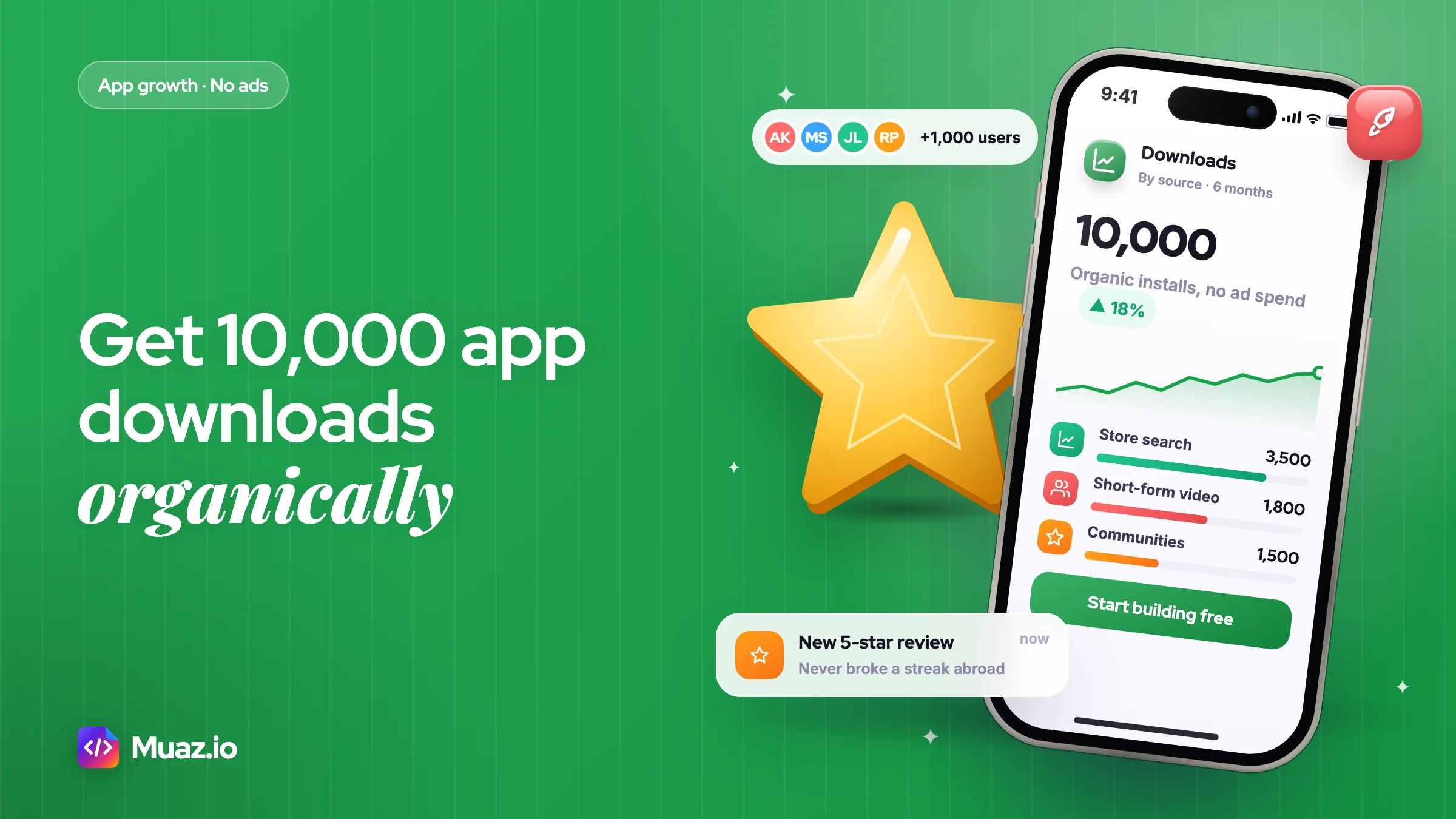
You get organic app downloads by launching to a waitlist, recruiting your first 1,000 users by hand, optimising your store listing for long-tail searches, collecting early reviews and running free channels such as communities, short-form video, launch platforms and referrals. Apple says almost 65% of App Store downloads happen directly after a search, so every early channel should feed your search ranking.
- That figure comes from Apple Ads, based on worldwide App Store data from 2022.
- Message your waitlist and personal network one by one, become useful in three communities where your users gather, and ask happy users for ratings by name.
- Featuring nominations, In-App Events, custom product pages, product page optimisation tests, pre-orders and Google Play pre-registration all cost nothing.
- Dropbox said its two-sided referral programme permanently increased sign-ups by 60%, and the reward was more storage, the thing users already wanted.
Your app went live on a Tuesday. By Friday it had 61 downloads: about 40 from friends, a dozen from a Slack group you belong to, and nine from strangers. The following week it had 23. Nobody is searching for it yet, you have no ad budget, and every guide you open says "do ASO" and "build a community" without telling you what to actually do on Monday morning.
This is the Monday-morning version of how to get app downloads organically. It is the plan I would follow to take a new iPhone or Android app from zero to its first 10,000 downloads without paying for a single install: what to set up before launch, which free channels move real numbers, the store tools most founders never switch on, and a 90-day schedule you can copy. Where I quote a number, it comes from Apple, Google or a named source. Where I estimate, I say so.
How to get app downloads organically: the maths behind 10,000
Getting 10,000 organic downloads means stacking five or six free channels that each deliver a few hundred to a few thousand installs, then letting App Store search and word of mouth compound them. No single post, launch or listing does it alone.
Break the goal down before you start. Over six months, 10,000 downloads is roughly 55 a day. Over 90 days it is about 110 a day. That sounds big on day one, when you have 12, but it is very achievable once search starts working, because search is where most App Store downloads come from.
Apple's own worldwide figures (from 2022) say that almost 65% of downloads happen directly after a search and that 70% of App Store visitors use search to discover apps. Its 2026 figure is that more than 850 million people visit the App Store every week. Your launch channels are not really the goal. Their job is to create enough early installs, ratings and relevance signals that the store starts sending you people for free.
Here is an illustrative split for a new habit-tracking app. These are not benchmarks, just a way to see how the pieces add up:
| Source | Example downloads | When it shows up |
|---|---|---|
| Waitlist and pre-orders | 600 | Launch week |
| Personal network and founder outreach | 400 | Weeks 1 to 2 |
| Communities (Reddit, Discord, forums) | 1,500 | Weeks 1 to 8 |
| Launch platforms and directories | 900 | Weeks 2 to 6 |
| Short-form video and build in public | 1,800 | Weeks 3 to 12 |
| Referrals and sharing loops | 1,300 | Weeks 4 onwards |
| App Store and Google Play search and browse | 3,500 | Weeks 4 onwards, growing |
| Total | 10,000 | About 3 to 6 months |
Notice that search does the heaviest lifting, but only after everything else has primed it. That is why the order of work matters more than the number of tactics. If you want the full channel list, including paid ones for later, see our breakdown of the 25 best app marketing channels.
What counts as an organic app download?
An organic download is any install that did not come from a paid ad: App Store or Google Play search and browse, featuring, direct links, word of mouth, referrals, press, social posts and communities.
Attribution tools split installs into "paid" and "organic", and organic is everything left over. That is useful but blunt. For this plan, split organic into three buckets so you can see what is working:
- Store-driven: people who found you through search, top charts, category browse, In-App Events or Apple and Google editorial features.
- Owned and earned: your waitlist, email list, website, social accounts, press and community posts. You can track most of these with links.
- User-driven: referrals, shared content, invites and plain word of mouth. This is the bucket that compounds.
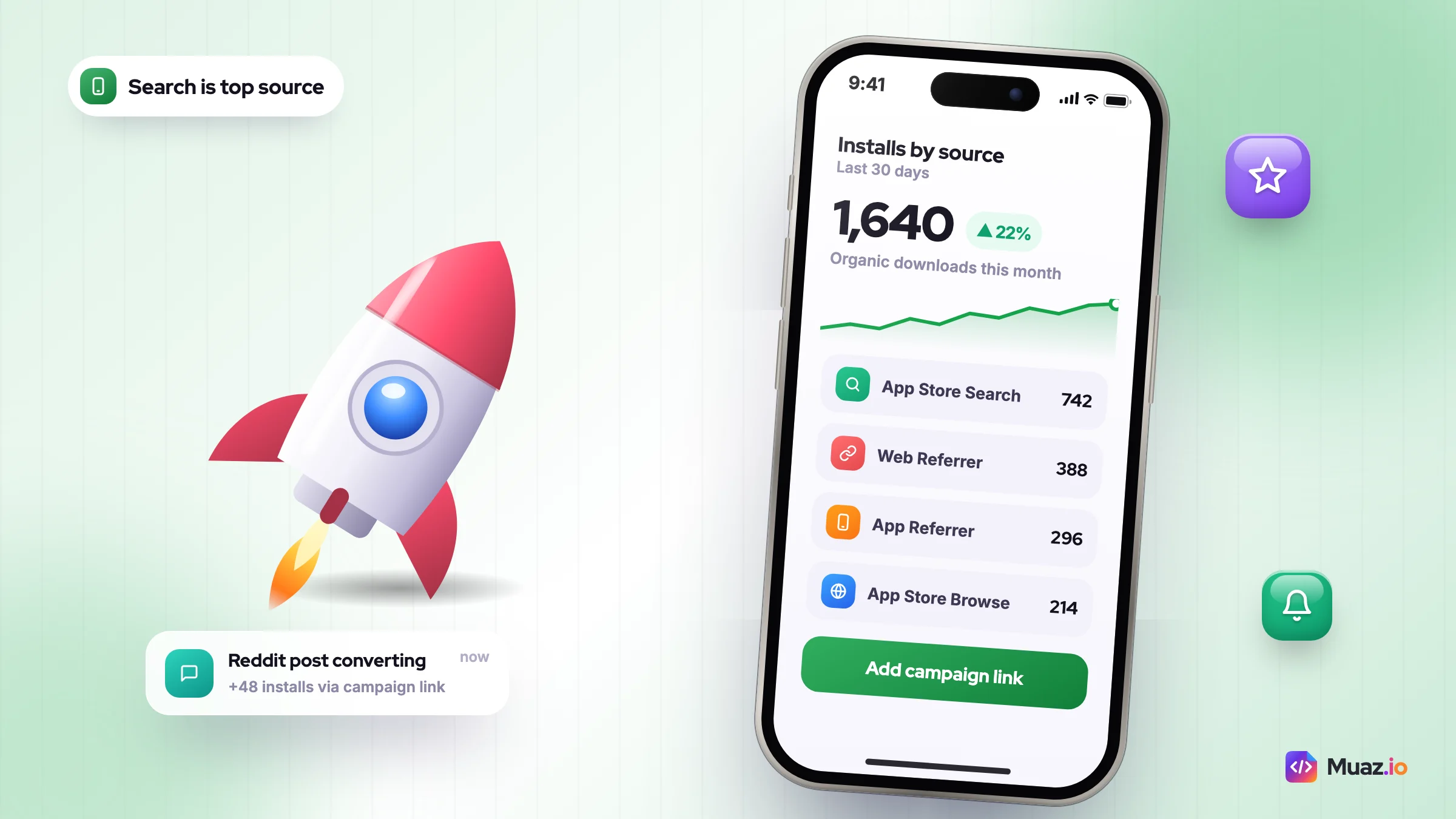
On iOS, App Store Connect shows source types such as App Store Search, App Store Browse, App Referrer and Web Referrer. Use campaign links for every post you make so "Web Referrer" is not a mystery. On Google Play, the Play Console acquisition reports do the same job.
Before launch: build a waitlist you can convert on day one
The founders who hit 10,000 fastest rarely launch to silence. They launch to a list. A list of 800 people who asked to be told when the app is live is worth more than any launch-day trick, because it gives you a burst of installs, early reviews and the first signal to the store algorithm in the same 48 hours.
Use the stores' own pre-launch tools
- App Store pre-orders: a brand-new app can go on pre-order 2 to 180 days before release. On release day it downloads automatically to everyone who pre-ordered, and they get a notification.
- Google Play pre-registration: users sign up from your listing and get a push at launch, and eligible devices can auto-install. Google says pre-registration campaigns can last 90 days, and you can offer one optional reward.
- TestFlight public link: Apple lets you invite up to 10,000 external testers, and you can put a public link in emails and social posts. A public beta is a waitlist that also gives you feedback.
Where the first 500 sign-ups come from
Write a one-page landing site with a single promise, three screenshots and an email field. Then share it where your future users already talk: niche subreddits, Facebook groups, Discord servers, LinkedIn if it is a work app, and your own contacts. Post the problem, not the product. "I kept losing my streaks when I travelled, so I am building a habit app that handles time zones. Want early access?" gets sign-ups. "Check out my new app" gets ignored.
If you are building in public on X, LinkedIn or Indie Hackers, every progress update can carry the waitlist link. Our guide to building in public for an app launch covers what to post each week.
How do you get your first 1,000 app users?
You get your first 1,000 users by hand: your network, your waitlist, a few communities where your users already gather, and direct one-to-one outreach. It does not scale, and that is the point. These people give you the reviews and feedback that make everything after it work.
Lenny Rachitsky looked at how the biggest consumer apps got their first users and found the same seven moves again and again: going where target users already gather, offline and online, inviting friends, creating scarcity and buzz, working with influencers, earning press and building a community before launch. Loom got its first roughly 3,000 users from its Product Hunt launch and the days after it. DoorDash put flyers up around Stanford.
Here is what I would do in the first 14 days:
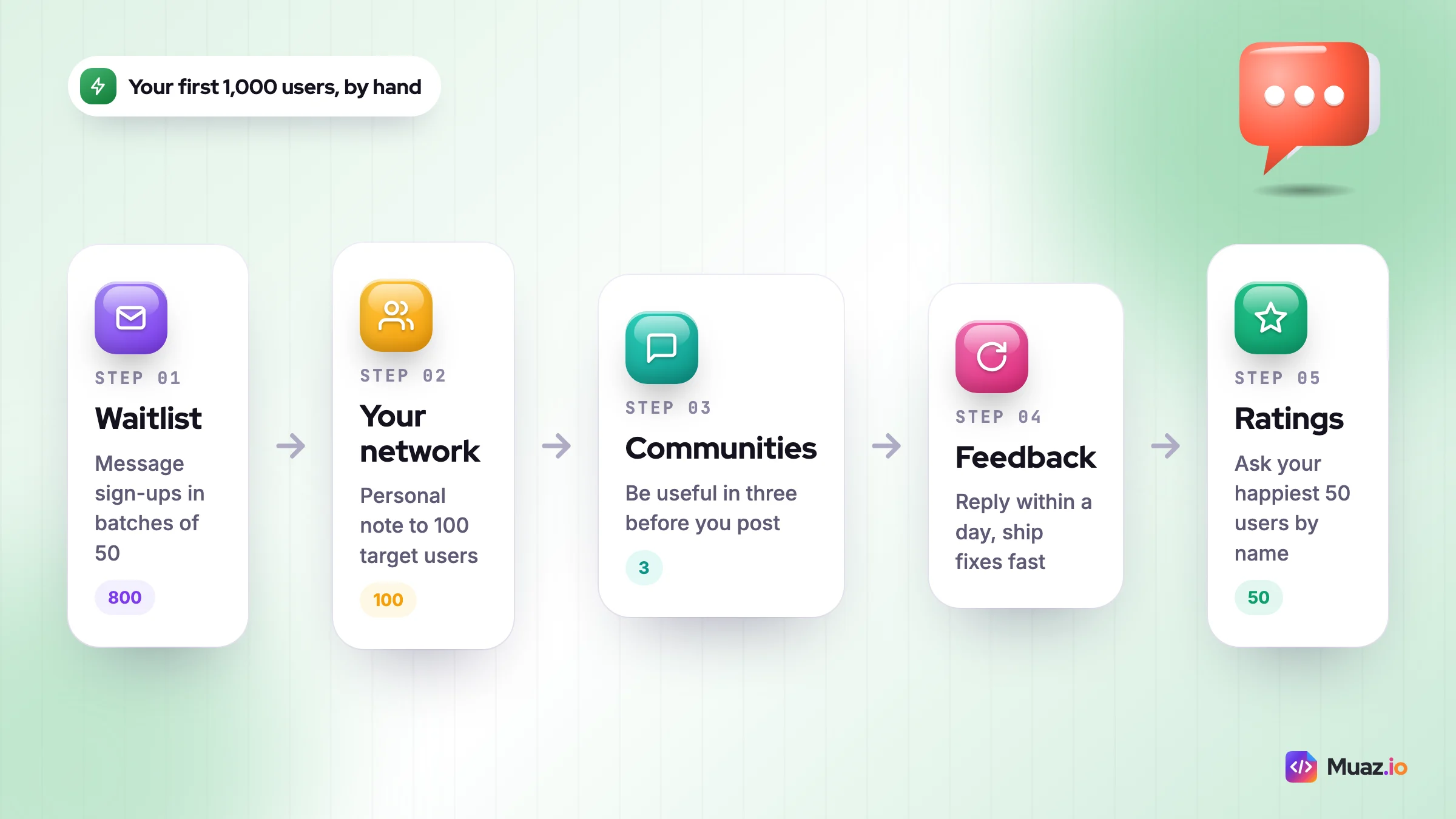
- Email or message every person on your waitlist personally, in batches of 50, with a direct App Store link and one line asking for honest feedback.
- Send a personal note to 100 people you know who fit the target user. Not a group blast. Ask each one to install it and tell you the first thing that confused them.
- Pick three communities where your user hangs out and become useful there before you post. Share the story of why you built it, not a sales pitch.
- Reply to every piece of feedback within a day. Ship small fixes fast and tell the person who reported it. People who see their idea shipped become your loudest fans.
- Ask your happiest 50 users, by name, to leave a rating. Early reviews matter more than almost anything else in this phase.
A free way to find which communities and keywords matter is to look at who you are up against. A competitor research scan shows the apps your users already use, what they complain about in reviews and how those apps describe themselves.
Make App Store search do the heavy lifting
App Store Optimisation (ASO) is the work of choosing the words and visuals on your store listing so that you rank for the searches your users make and turn more page views into installs. For an app with no ad budget, it is the one channel that keeps working while you sleep.
Apple gives you a small number of indexed fields, so every character counts. According to Apple's product page guidelines, you get:
| Field | Limit | What I would put there |
|---|---|---|
| App name | 30 characters | Brand plus your single biggest keyword |
| Subtitle | 30 characters | A benefit phrase with a second keyword |
| Keyword field | 100 characters | Comma-separated terms, no spaces, no repeats |
| Promotional text | 170 characters | Current news or offer (not indexed for search) |
| Screenshots | Up to 10 | First three tell the whole story |
| App preview video | Up to 30 seconds, up to 3 | Show the core action in the first seconds |
Pick keywords you can actually win
A brand-new app will not rank for "habit tracker" in month one. It can rank for "habit tracker for travel" or "streak app with time zones". Target long, specific phrases where the top results are weak, then move up to broader terms as your ratings and downloads grow. Check each phrase by typing it into the App Store yourself: if the top five apps have thousands of ratings, park it for later.
Our free ASO keyword tool helps you fit the best terms into the 30-character name and subtitle and the 100-character keyword field. For the full method, from keyword research to localisation, read the complete ASO guide for 2027.
Screenshots are your real advert
Most people decide from the first three screenshots without reading a word of the description. Lead with the outcome ("Never break a streak abroad") rather than the feature list, use big readable captions, and make the first image work on its own. If you need every required iPhone and iPad size, the free App Store screenshot generator exports them in one go.
Ratings and reviews: the cheapest multiplier you have
Ratings help in two ways. They make people more likely to install once they land on your page, and the volume and recency of ratings is one of the signals the stores use. An app with 4 reviews and an app with 400 can sit side by side in search, and the second one wins most taps.
Apple's rules are simple. You can show the system rating prompt up to three times in a 365-day period, so ask at a moment of success: after a completed workout, a finished project or a seven-day streak, not on first launch. You can reply to every review in App Store Connect, and the reviewer is notified and can update their review. Apple suggests prioritising the lowest ratings and reviews that mention technical problems.
- Ask for a rating only after a clear win inside the app. Never gate features behind a review.
- Reply to every 1 and 2-star review within 48 hours with a fix or a date. Keep it short and human.
- When a bug fix ships, tell the people who reported it. Some will change their rating.
- Use the summary rating reset sparingly, if at all. Apple notes that old written reviews stay on the page.
Community marketing without getting banned
Communities are the fastest free source of your first few thousand installs, and also the fastest way to get banned if you treat them like a billboard. Reddit, Discord servers, Facebook groups, Slack communities and niche forums all reward people who help first and mention their product second.
Reddit's communities set their own rules on self-promotion, and many ban it outright, so read the sidebar of every subreddit before you post. The rule of thumb many moderators use is that most of your activity should be genuine participation rather than promotion. Answer questions in your niche for two weeks before you ever link your app.
A post format that tends to work in builder-friendly subreddits looks like this. Copy it and adapt it:
Title: I spent 4 months building a habit app because every tracker broke my streak when I travelled. Here is what I learned.
Body: Two or three short paragraphs on the problem and what you tried. One paragraph on what surprised you while building. A short list of what the app does differently. "It is free on iOS if you want to try it, link in the comments. I would love blunt feedback on the onboarding."
Then stay in the thread for hours and reply to every comment. The comments are where most installs happen. We go much deeper, including which subreddits allow app posts, in our guide to Reddit marketing for apps.
Short-form video and building in public
TikTok, Instagram Reels and YouTube Shorts are the closest thing to free reach left for consumer apps. A short clip can reach thousands of people who have never heard of you, because those feeds show content based on interest rather than on who follows you.
You do not need to dance or be on camera. The formats that tend to work for apps are simple:
- Problem, then app: show the annoying thing for three seconds, then show the app fixing it.
- Screen recording with a hook: "This app does something your calendar cannot." Then show it.
- Founder diary: one clip a day on what you built, what broke and how many downloads you got.
- Before and after: the messy notes app versus your clean result.
Volume beats polish. Post daily for 30 days before you judge the channel, and repurpose each clip to all three platforms. Our TikTok, Reels and Shorts playbook for apps has hooks, scripts and a posting calendar.
Free app promotion websites and launch platforms: which are worth it?
Free app promotion websites are directories and launch platforms where you can list an app at no cost, such as Product Hunt, BetaList, AlternativeTo and Indie Hackers. A few can send thousands of visitors. Most send a trickle, so pick a small set and do them properly.
Product Hunt is still the big one for apps aimed at early adopters. Its own launch guide says 12:01 am Pacific Time is the best time to launch for makers planning ahead, and that the best day is the one on which you are most prepared. Line up your supporters, a short demo video and someone on hand to reply to comments all day.
| Platform | Best for | Effort | My take |
|---|---|---|---|
| Product Hunt | Productivity, AI, tools, design apps | High | Worth one well-prepared launch |
| BetaList | Pre-launch apps collecting testers | Low | Free listing, slow queue |
| AlternativeTo | Apps that replace a known product | Low | Steady long-tail traffic |
| Indie Hackers | Founder and developer tools | Medium | Best with a build story |
| Hacker News (Show HN) | Technical or developer apps | Medium | Spiky, honest feedback |
| Niche newsletters | Any app with a clear audience | Medium | Pitch the editor personally |
| Generic "submit your app" sites | Almost nobody | Low | Skip most of them |
Generic app review sites and long "100 websites to promote your app" lists are mostly a waste of a launch week. A few will link back to you, which helps a little with web search, but they rarely send real users. For a full list with dates and requirements, see where to launch an app on Product Hunt, AppSumo and 20+ platforms.
How do you build an app referral loop that actually works?
An app referral loop rewards existing users for bringing in new ones, ideally with a reward on both sides that is tied to the core value of your app. Done well, it turns every satisfied user into a small acquisition channel.
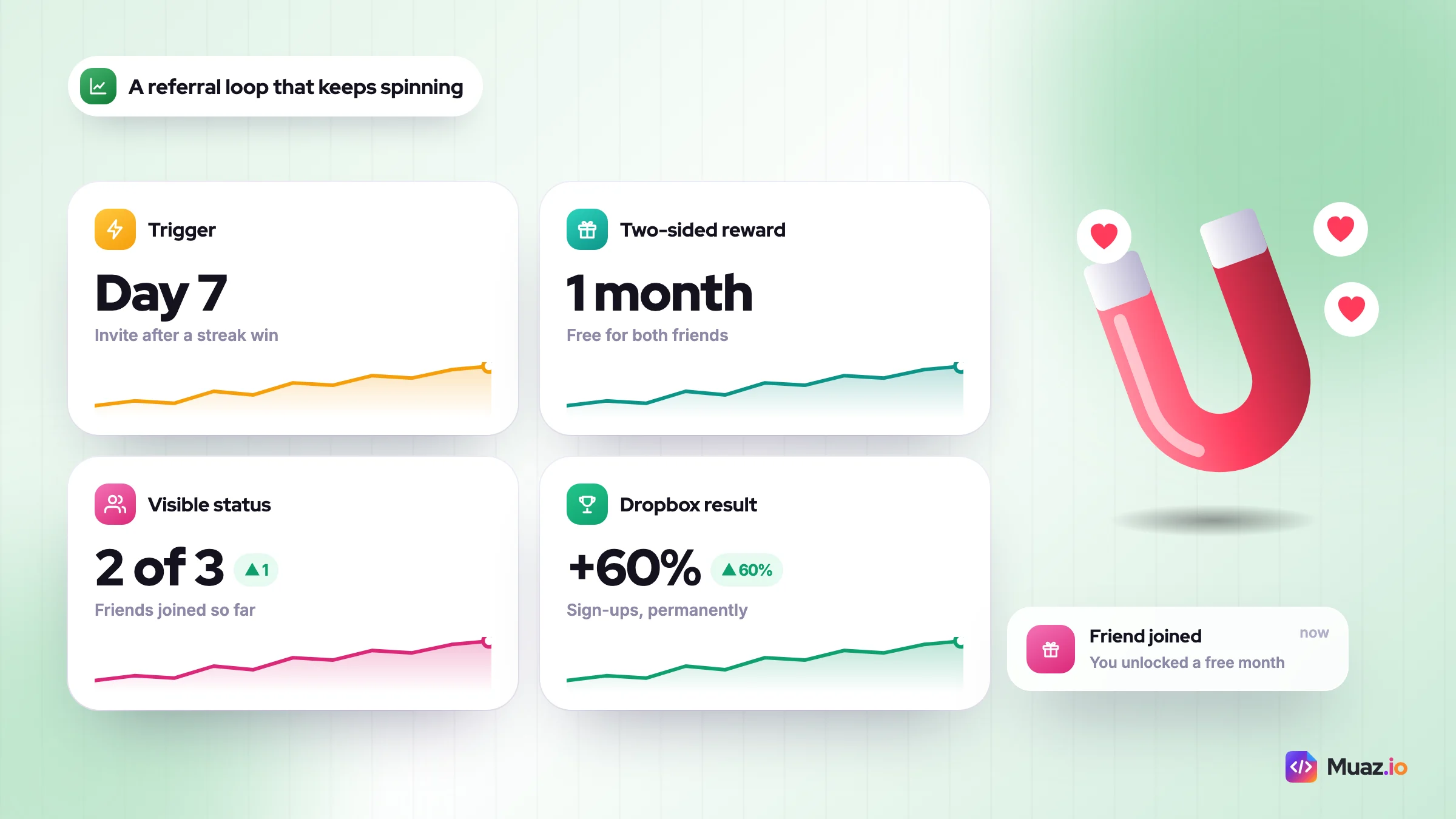
The classic example is Dropbox. In Drew Houston's Startup Lessons Learned talk, the slide reads: a referral programme with a two-sided incentive permanently increased sign-ups by 60%. The reward was more storage, which is exactly what a Dropbox user wants. That is the lesson: give people more of the thing they already value.
For a mobile app, a referral loop has four parts:
- A trigger: ask for the invite right after a success moment, the same moment you would ask for a rating.
- A share link that opens the App Store or Google Play for new users and the right screen for existing ones (deferred deep linking).
- A reward for both sides: extra features, a free month, credits, themes or content.
- A visible status: show "2 of 3 friends joined" so the referrer comes back.
Subscription apps have extra constraints on iOS. RevenueCat's guide to referral programmes for mobile apps suggests starting with a simple MVP, such as a separate subscription product with a free-month introductory offer for the new user, making sure App Review can test the flow, and requiring referrers to claim rewards manually to cut fraud.
Even without a formal programme, build sharing into the product. A habit app can let users share a streak card. A budgeting app can share a savings milestone. A recipe app can share a shopping list that opens in the app. Each shared item is a free ad made by a real user.
Your website, SEO and AI answers
Your website is the only channel you fully own. Treat it as a second store listing that can rank on Google and be quoted by ChatGPT, Gemini and Perplexity.
- Build one page per main use case ("habit tracker for shift workers", "habit tracker for travel") and answer the questions people search for.
- Add Apple's Smart App Banner meta tag so iPhone visitors in Safari see a one-tap link to your App Store page.
- Use the official App Store and Google Play badges and QR codes on every page, email signature and printed flyer.
- Publish short, honest comparison pages against the apps people already use. These pages are often what AI assistants quote.
- Collect emails on the site, so every visitor is a person you can tell about the next update.
AI assistants are quickly becoming a discovery channel for apps, and they favour pages with clear, factual answers, tables and named entities. Our guide to app discoverability on ChatGPT, Gemini and Perplexity shows how to structure those pages.
Free store tools most founders never switch on
Apple and Google both give you promotion tools that cost nothing beyond your time. Few small developers use all of them, which is exactly why they are worth your time.
| Tool | Store | What it does | Key limit |
|---|---|---|---|
| Featuring Nominations | App Store | Pitch your launch or update to the editorial team | At least 2 weeks notice, up to 3 months ahead |
| In-App Events | App Store | Event cards on your product page, in search and in editorial picks | 10 published at once, up to 31 days each |
| Custom product pages | App Store | Extra page versions for different audiences and keywords | Up to 70 additional pages |
| Product page optimisation | App Store | A/B test icon, screenshots and previews | Up to 3 treatments, up to 90 days |
| Store listing experiments | Google Play | Test graphics and localised descriptions | Up to 2 variants per experiment |
| Pre-registration | Google Play | Sign-ups and auto-install on launch day | Campaign ends after 90 days |
Sources: Apple's pages on getting featured, In-App Events, custom product pages and product page optimisation, and Google's store listing experiments help page.
Two of these deserve special attention. Submit a featuring nomination for your launch as soon as you have a date, and again for every meaningful update. And run an In-App Event, such as a 30-day challenge or a seasonal theme, every month: event cards show on your product page, in search results for people who already have the app, and in editorial selections on the Today and Apps tabs, which gives a small app a second shot at attention.
Custom product pages let you build a page for each audience you pitch. Send Reddit visitors to a page whose screenshots match the post, and assign keywords so the page can appear in search for those terms.
How long does it take to get 10,000 app downloads?
For a new app with no ad budget, 10,000 organic downloads usually takes three to nine months, depending on how big the niche is, how strong the listing is and how consistently you run the free channels. That is my estimate from the channel maths above, not a guarantee.
Apps in large, searchable categories with a sharp angle can get there in weeks after a good launch. Apps in tiny niches may plateau at a few thousand, which can still be a good business if the users pay. Here is the pace I would plan around:
| Phase | Focus | Example running total |
|---|---|---|
| Pre-launch (4 to 8 weeks) | Waitlist, TestFlight beta, pre-orders, featuring nomination | 0 (500 to 1,000 sign-ups) |
| Days 1 to 30 | Launch to list, first 1,000 users, reviews, two community posts | 1,000 to 2,000 |
| Days 31 to 60 | Daily short video, launch platforms, ASO round two, referral MVP | 3,000 to 5,000 |
| Days 61 to 90 | In-App Events, custom product pages, web pages, double down on the top channel | 5,000 to 8,000 |
| Months 4 to 6 | Search compounding, localisation, partnerships | 10,000 and up |
The example totals are illustrative. Your own numbers will be lumpy: a good Reddit thread or video can add a thousand installs in a day, and then nothing happens for two weeks. Judge channels over four-week windows, not single days.
Downloads are only half the story. If people leave after a day, the stores notice and your growth stalls. Fix onboarding and the first-week experience alongside acquisition, using the ideas in our guide to app retention marketing.
When does it make sense to pay for help?
Going without ads does not mean going without tools. Some free app marketing tools are enough at this stage: Apple and Google analytics, a link shortener with campaign tags, a screenshot tool and a keyword tool. Paid ASO tools, an app promotion service or a freelance app marketer start to make sense once you know which channel works and want to scale it.
- Best ASO tools: pay for one only when you are tracking 50 or more keywords across several countries. Before that, manual searches and a free tool are fine.
- App marketing agency cost: agencies usually charge monthly retainers, and many expect an ad budget on top. For a pre-revenue app, that money is better spent on building.
- Hire an app marketer: a part-time freelancer for content or community work can be good value once you have a repeatable format.
- Research reports: a one-off competitor report is cheaper than a month of guessing.
Muaz.io sits in this gap. It builds native iPhone apps and then helps them grow with ASO, 30/60/90-day Growth Studio plans and competitor research reports, which start at $49 one-time. If you have an idea but no app yet, you can start building an app free and use this plan from day one.
Your 90-day no-ads launch checklist
Copy this into your task manager. It is the condensed version of everything above, and it fits inside the wider app marketing plan for 2027. If you want the week-by-week version with paid channels added later, use the 90-day app launch marketing plan.
Before launch
- One-page website with a waitlist form, Smart App Banner and store badges
- TestFlight public beta link shared in three communities
- App Store pre-order or Google Play pre-registration switched on
- Featuring nomination submitted at least two weeks before launch
- App name, subtitle and keyword field written around three long-tail phrases
- First three screenshots tell the whole story on their own
Launch month
- Personal message to every waitlist sign-up and 100 people you know
- Rating prompt placed after a clear success moment
- Reply to every review and every piece of feedback within 48 hours
- Two story-led community posts and a Product Hunt launch
- Campaign links on every post so you can see what drove installs
Months two and three
- One short video a day across TikTok, Reels and Shorts
- Referral MVP with a two-sided reward tied to your core value
- One In-App Event a month and one custom product page per audience
- Second round of keyword changes based on what is ranking
- Review the numbers every four weeks and double down on the top two channels
Do the boring parts every week and the 10,000 will come. Most apps that stall do so because the founder tried each channel once, for a few days, and moved on. Pick your channels, run them for a full month, measure, then decide.
Free: The 90-Day No-Ads App Launch Checklist
A copy-ready checklist and tracker covering pre-launch, launch month and months two and three, with outreach and community post templates.
We’ll email the resource and a few practical tips. Unsubscribe in one click. We never sell your data.

Monjur builds Muaz.io and incorporated MotionTrust Digital in September 2022, where he leads Amazon strategy across the client base. Eight years in e-commerce and marketplace marketing taught him how much growth a great mobile app unlocks, so every guide here is tested against the real product and current App Store rules before it goes live.
Questions about 2027 guide
Short, direct answers. Still curious? Ask in the builder; the assistant knows your project.
How do you get app downloads organically?
You get organic app downloads by launching to a waitlist, recruiting your first 1,000 users by hand, optimising your store listing for long-tail searches, collecting early reviews and running free channels such as communities, short-form video, launch platforms and referrals. Apple says almost 65% of App Store downloads happen directly after a search, so every early channel should feed your search ranking.
Search is the biggest free channel: almost 65% of App Store downloads happen directly after a search.
That figure comes from Apple Ads, based on worldwide App Store data from 2022. It means your launch channels matter mainly because they create the installs, ratings and relevance that make the store rank you. Start with long-tail keywords you can win, then move to broader terms.
Your first 1,000 users come from personal outreach, not from a growth hack.
Message your waitlist and personal network one by one, become useful in three communities where your users gather, and ask happy users for ratings by name. These early users give you the reviews and feedback that every later channel depends on.
Apple and Google give you free promotion tools that most small developers never switch on.
Featuring nominations, In-App Events, custom product pages, product page optimisation tests, pre-orders and Google Play pre-registration all cost nothing. Each one gives a new app another chance at attention in the store.
A two-sided referral reward tied to your core value is the most reliable way to make growth compound.
Dropbox said its two-sided referral programme permanently increased sign-ups by 60%, and the reward was more storage, the thing users already wanted. Trigger the invite after a success moment and show referrers their progress.
How long does it take to get 10,000 app downloads?
For a new app without an ad budget, plan for three to nine months. Apps in large, searchable categories with a sharp angle can get there faster after a strong launch, while very small niches may plateau earlier. Judge each channel over four-week windows rather than single days.
Do free app promotion websites work?
A few do. Product Hunt, BetaList, AlternativeTo, Indie Hackers and Show HN can send real users when the audience fits your app. Most generic "submit your app" directories send very little traffic, so pick a short list and do those launches properly.
Can you launch an app without a marketing budget?
Yes. You can launch with time instead of money by using a waitlist, TestFlight public beta, pre-orders or pre-registration, communities, short-form video and the free store tools. Spend money later, on tools or help, once you know which channel works for your app.
How many times can I ask users to rate my iOS app?
Apple allows the system rating prompt up to three times in a 365-day period. Show it after a clear success moment inside the app, never on first launch, and reply to low-star reviews in App Store Connect so reviewers can update their rating.
Keep reading
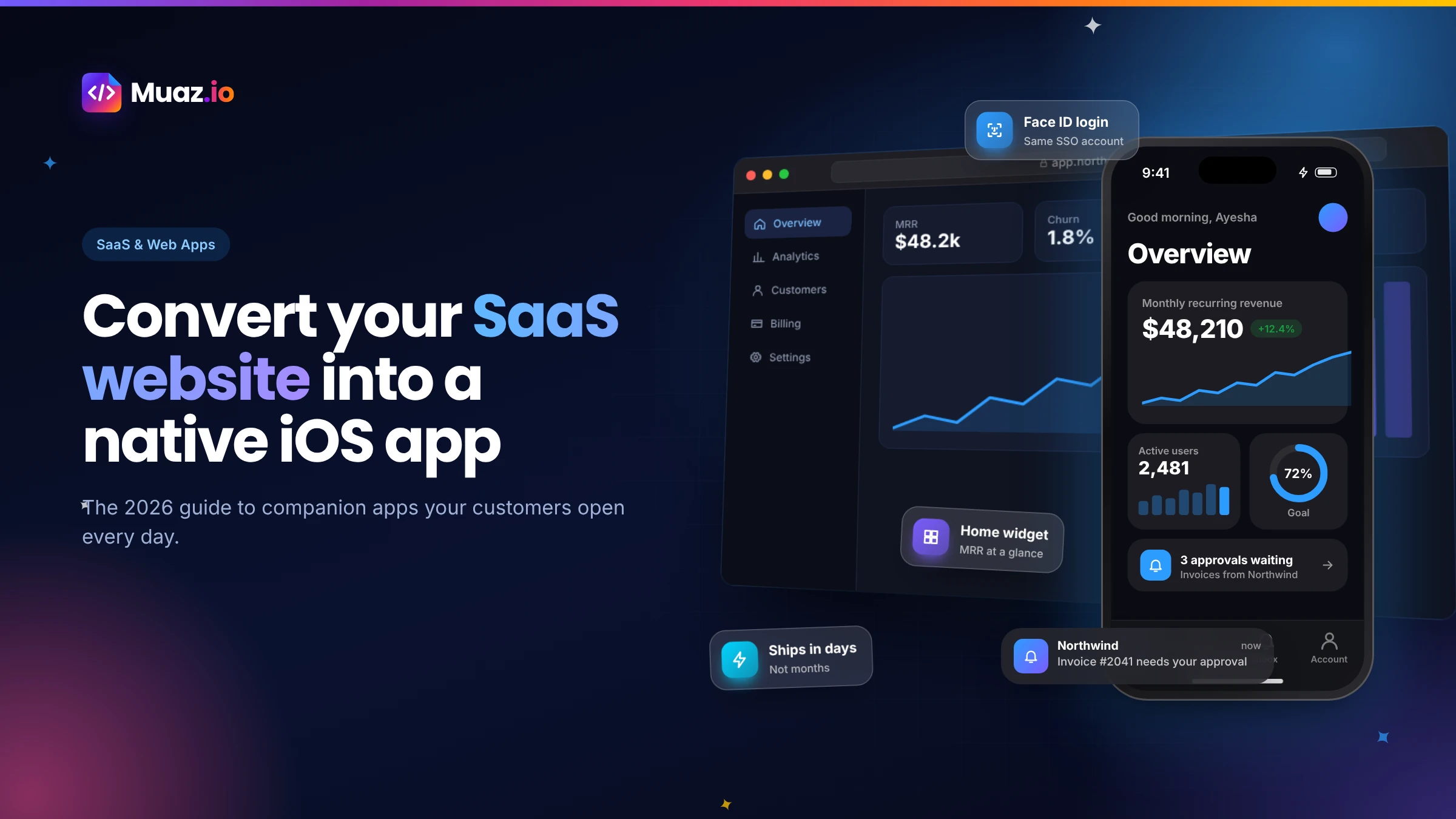 SaaS & Web Apps18 min readHow to Convert a SaaS Website into a Native iOS App Using AI (2026 Guide)
A practical, step-by-step guide to turning your SaaS web app into a native iPhone app with AI: what to build, how to connect your API and login, push alerts, App Review and cost.
Monjur Hossain· Tools & Comparisons16 min read10 Best AI iOS App Builders in 2026: Features, Pricing & Native Support
We compared 10 AI app builders specifically for iPhone apps: native output, App Store publishing, code ownership, design quality and 2026 pricing, with honest picks by use case.
Monjur Hossain·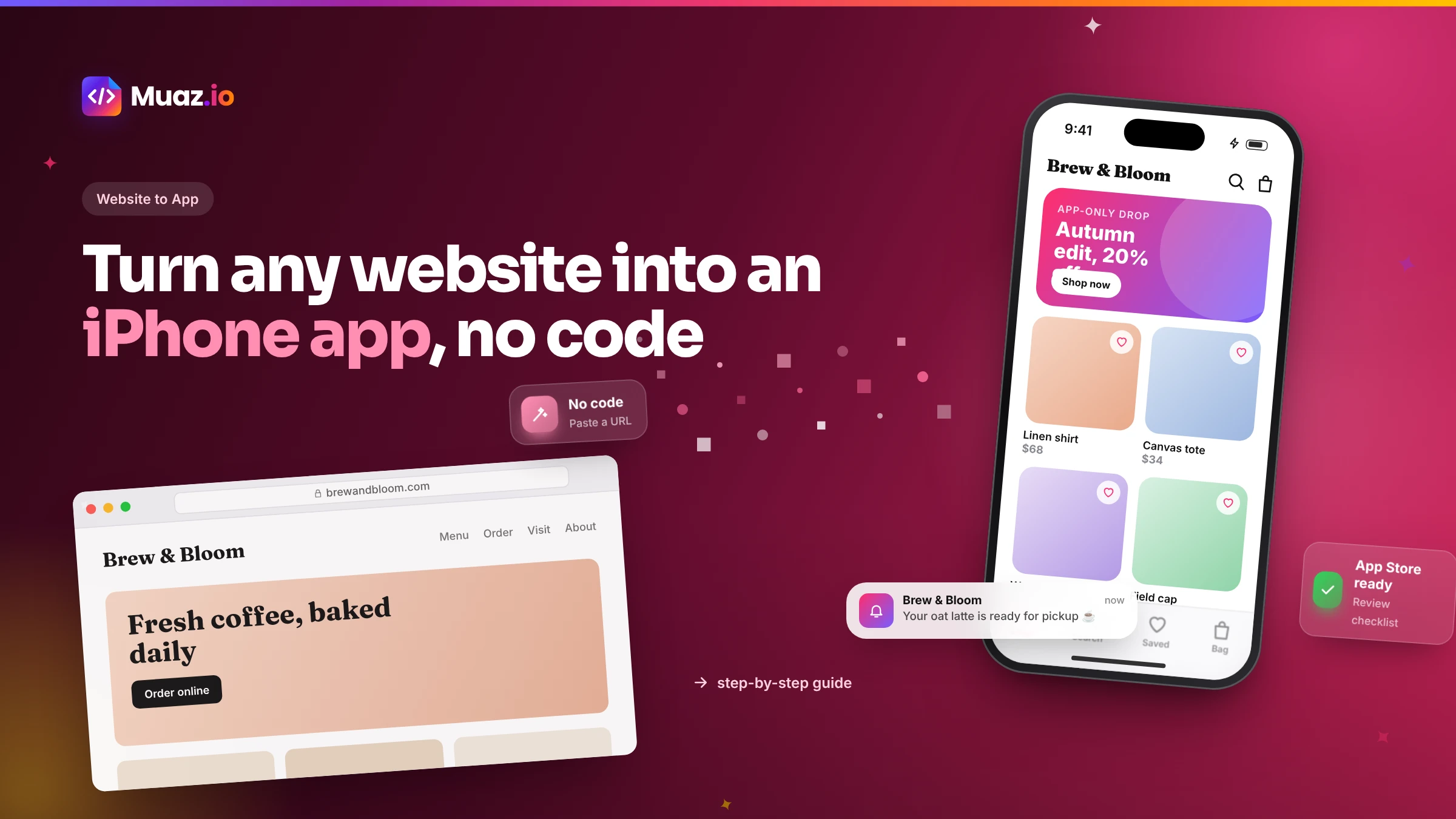 Website to App15 min readHow to Turn Any Website into an iPhone App Without Coding (Step-by-Step)
A step-by-step, no-code guide to turning your website into a real iPhone app: checking readiness, choosing native vs WebView, AI conversion, testing on TestFlight and App Store approval.
Monjur Hossain·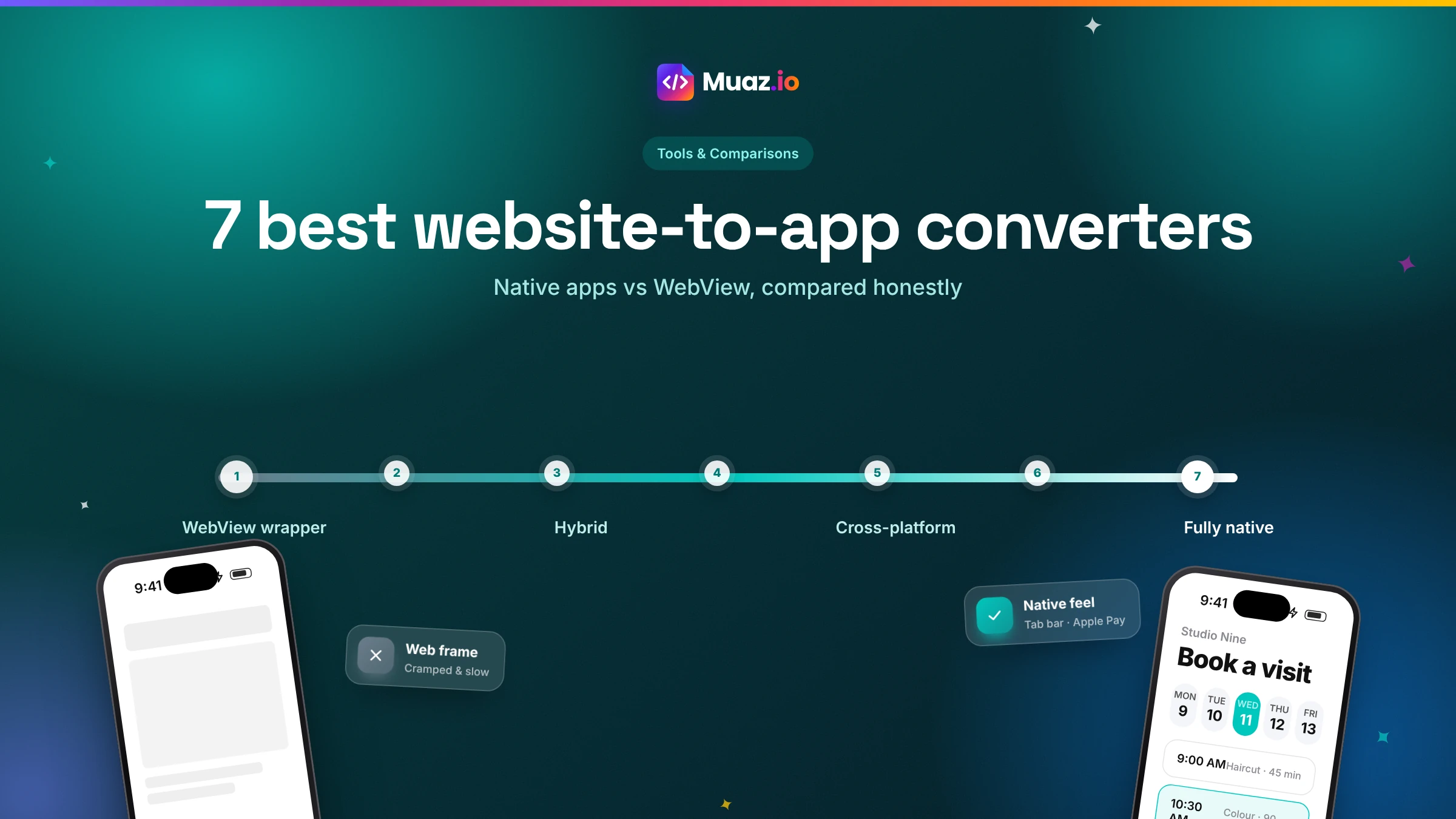 Tools & Comparisons15 min read7 Best Website-to-App Converters in 2026: Native Apps vs WebView
An honest comparison of 7 website-to-app converters in 2026, from WebView wrappers to native AI rebuilds: how each works, App Review risk, features, ownership and published pricing.
Monjur Hossain·Tools and products for the next step
- Paste a URL, get three original designs
- Free research before you pay
- 5, 10 or 20 App Store rivals analysed
- Review themes, pricing and gaps
- Screenshots, metadata and privacy labels
- TestFlight and submission checklist
Where our numbers come from
Third-party figures are estimates published by the sources below. Prices and rules change; check the source before you decide.
- Apple Ads: App Store reach and search statisticsads.apple.com/app-store
- Apple Developer: TestFlightdeveloper.apple.com/testflight
- Apple Developer: Offering your apps for pre-orderdeveloper.apple.com/app-store/pre-orders
- Google Play Console Help: Pre-registrationsupport.google.com/googleplay/android-developer/answer/9084187
- Apple Developer: Creating your product pagedeveloper.apple.com/app-store/product-page
- Apple Developer: Ratings, reviews and responsesdeveloper.apple.com/app-store/ratings-and-reviews
- Apple Developer: Getting featured on the App Storedeveloper.apple.com/app-store/getting-featured
- Apple Developer: In-App Eventsdeveloper.apple.com/app-store/in-app-events
- Apple Developer: Custom product pagesdeveloper.apple.com/app-store/custom-product-pages
- Apple Developer: Product page optimisationdeveloper.apple.com/app-store/product-page-optimization
- Google Play Console Help: Store listing experimentssupport.google.com/googleplay/android-developer/answer/6227309
- Lenny's Newsletter: How the biggest consumer apps got their first 1,000 userswww.lennysnewsletter.com/p/how-the-biggest-consumer-apps-got
- Drew Houston: Dropbox Startup Lessons Learned (slides)www.slideshare.net/gueste94e4c/dropbox-startup-lessons-learned-3836587
- RevenueCat: How to build a referral program for mobile appswww.revenuecat.com/blog/growth/how-to-build-a-referral-program-for-mobile-apps